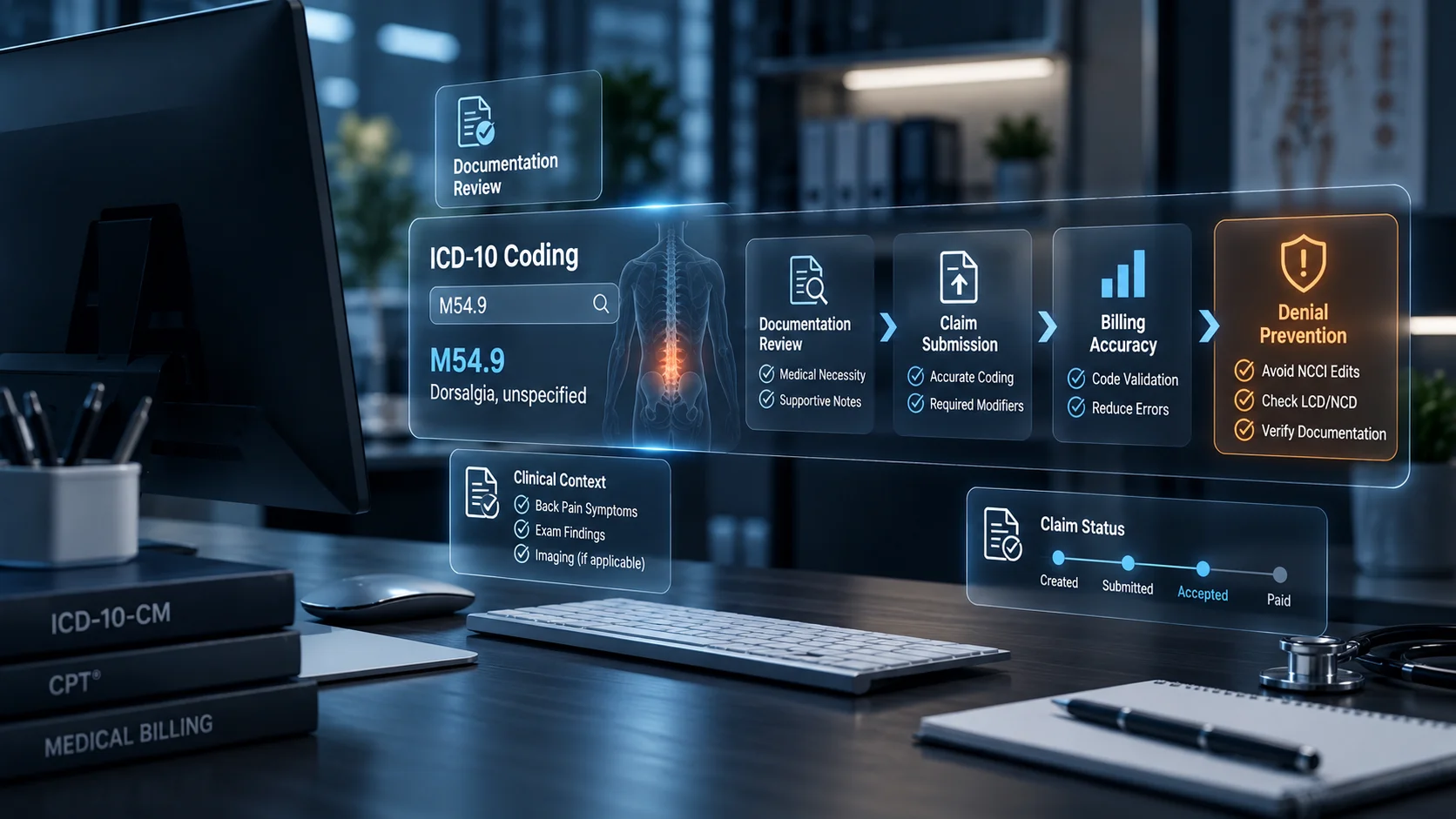
If you’re still scratching your head over a denied claim that you thought “looked clean,” it’s likely that a code got in your way. In medical billing, POS codes inform payers where care was provided, and none are more critical than POS 11 in medical billing.
CMS defines POS 11 as “a physician’s office. ” It immediately impacts reimbursement, compliance, and claim adjudication.
However, it is among the most frequently misapplied codes, resulting in expensive delays and unnecessary denials.
In this guide, we’ll explain POS 11, how it differs from other POS codes, and how using it correctly will safeguard your revenue cycle and help you avoid payer audits.
What is POS 11 in Medical Billing?
Accuracy is crucial in medical billing. One mistaken digit or mislabeled code could mean reimbursement differences, Insurance claim denials, or delayed payment.
Here’s where Place of Service or POS codes come in. POS codes are a standard form of communication for providers to tell payers where care was administered. POS 11 is one of the most utilized POS codes.
So, what is pos meaning in medical billing?
As defined by the Centers for Medicare & Medicaid Services (CMS), POS 11 indicates an “Office” place of service. It is relevant when physicians, other practitioners, or groups furnish services in an office setting.
It might be a primary care clinic, a specialty practice, or a group office where patients are seen for consultations, checkups, or regular treatment. POS 11 differs from POS 21 (inpatient hospital) or POS 12 in medical billing, as POS 11 is specifically for office-based service.
Why does this matter? Reimbursement rates are calculated differently for a treatment depending on the POS code. For example, POS 11 on a claim means services were delivered in a physician’s office — not a hospital, ambulatory surgical center, or telehealth setting.
When this code is misreported, payments may be drastically decreased, or in some cases, even denied altogether. For example, if POS 22 (“Outpatient Hospital”) is mistakenly coded instead of POS 11, payments may be reduced because hospitals are paid under different fee schedules.
But, more than reimbursement, the correct POS code also impacts compliance. Regulatory agencies and payers carefully scrutinize billing accuracy to prevent fraud, waste, or abuse. Repeated POS reporting mistakes can bring audits, fines, and even upcoding claims.
In other words, POS 11 = Office visits. It helps providers get paid correctly for their work and stay in payer compliance.
Why POS Codes Matter in Medical Billing?
Accuracy is not an option for health care reimbursement. It’s the whole game. POS Codes—It’s All in the Details. Place of Service or POS codes might seem unimportant, but they can make or break a claim.
They are GPS markers that help payers see where patient care occurs. Without them, insurers would shoot in the dark, and providers would be mired in nightmares of processing delays, denials, and underpayments.
Why do POS codes matter in medical billing?
For one, they set reimbursement rates. Various care places have various overhead expenses, staff, and resource demands.
An identical service, such as a cardiology consult, performed in POS 11 (office) is generally reimbursed differently than the same service in POS 22 (outpatient hospital). If providers mistakenly report the wrong POS, they could accidentally slash their reimbursements or tag their practice as a suspicious biller.
Compliance is another crucial reason for POS codes. Insurance companies and government programs, such as Medicare and Medicaid, scrutinize bills closely for fraud and abuse.
Abusing POS codes, whether accidentally or intentionally, may result in audits, clawbacks, or penalties. Businesses that perpetually get the code wrong are vulnerable to reputation damage and added attention, which could reduce profits and trust.
Correct POS coding
Correct POS coding also creates transparency from the patient’s side. Patients need their Explanation of Benefits (EOB) to understand where they received care and why their copay or deductible appears the way it does.
If a claim has an incorrect Place of Service or if they perceive overbilling, patients may question the validity of their provider’s billing. That can undermine patients’ trust, a resource no clinic can afford to squander. Finally, POS codes help simplify claim processes. Claims that get paid the first time, get paid first, get paid fast for details, and are less work for the team.
“Errors,” on the other hand, are preventable denials that cause billers to refile, appeal, or chase down payments. By making workers apply for public assistance only to be rejected, each denial consumes staff time and adds administrative overhead.
Ultimately, POS codes are small number sequences with considerable implications. They ensure that providers are adequately paid, that billing teams are compliant, and that patient trust is maintained.
In other words, knowing POS codes is not just about adhering to rules. It’s about preserving revenue, reputation, and relationships.
Deep Dive into POS 11
One of the most common places of service codes in medical billing is POS 11. It is for an “Office” — not an inpatient, institutional, or ambulatory care space where healthcare providers furnish preventive or specialized outpatient services.
For example, an individual doctor’s private practice, a group clinic, or a specialist’s consultation room. If you have ever seen your primary care doctor or perhaps a skin specialist in their office, the service was likely billed using POS 11.
Definition and Scope of POS 11
The CMS says POS 11 is the site of service, where the health care provider performs exams, consultations, and other treatment in a permanent office setting.
Office settings are smaller, privately owned, and generally have less overhead than hospital outpatient facilities. That difference directly translates to what providers get reimbursed and how they bill.
POS 11 is not confined to a general practice. Doctors like cardiologists, neurologists, endocrinologists, and others often use it in their offices. The code offers insurers a uniform means of gauging the cost landscape of the service rendered.
Why POS 11 Matters in Reimbursement
The rates of reimbursement associated with POS 11 are better than those of hospital outpatient. Hospitals have more generous reimbursements thanks to their extensive infrastructure, staffing, and technology. Office visits, however, are expected to be cheaper.
For instance, billing a level-three established patient visit to POS 11 (office) instead of place of service 22 (hospital outpatient) will result in different payments for the same CPT code.
The payer assumes that they pay less because office-based services use fewer resources. For facilities, it is imperative to report POS 11 accurately. A miscoded POS could lead to lower payments or even a denial.
Common Scenarios for POS 11
- Routine check-ups and preventive care: Annual physicals, vaccinations, and wellness visits.
- Specialist consultations: Dermatology exams, cardiology follow-ups, endocrinology reviews.
- Minor procedures: Wound care, in-office lab tests, and minor surgical procedures that don’t require hospital admission.
- Chronic disease management: Diabetes, hypertension, or asthma management handled directly in the office.
Each of these services hinges on accurate POS reporting. Billing a hospital outpatient code for an office-based service could lead to denied claims and raise compliance red flags.
Compliance and Risk Considerations
Aberrant POS 11 usage can lead to far-reaching problems. For example, if a practitioner gives care in a hospital outpatient department and bills it under POS 11, without knowing the correct POS code.
In that case, the insurer may consider the bill to be false documentation. This slip-up could invite audits, requests for repayment, or punishment.
Providers who toggle between hospital systems and their practices face a high compliance burden.CMS and private payers monitor POS coding to identify fraud or abuse.
Yet clinic-based providers who regularly “upcode” to home services will be in trouble. Precision with coding, solid documentation, and staff education are key safeguards.
Why Patients Care About POS 11
From the patient’s point of view, POS 11 means less you spend out of pocket.
Since office visits are usually the least expensive form of care compared with hospital-based visits, POS 11 will mean that patients see lower copays and deductibles on the services billed under the more cost-effective POS 11. Transparency in billing is also a trust builder.
And when patient EOBs reflect POS matches on their POS code, patients are further assured that the practice is billing honestly and accurately.
Final Takeaway
POS 11 is more than just a code in medical billing: It’s a key to helping you bill accurately, compliantly, and effectively. It manifests in reimbursement rates, influences patient responsibility, and is a badge of legitimacy for insurers.
Providers who practice the POS 11 guideline correctly are the key to consistent revenue, patient trust, and adherence confidence. Put simply, POS training 11 is a must-have for any practice operating within an office.
Key Differences Between POS 11 and Other Common Codes
The explanation of place of service 11 in medical billing becomes even more transparent as we compare it to other well-known place of service codes.
Although POS 11 is an “office,” the gradient between office visits and those at other locations (hospitals, outpatient centers, patients’ homes) is considered.
Its role in reimbursement, compliance, and patient experience is paramount. Failing to understand these distinctions is why claims are flagged or denied.
Let’s discuss how POS 11 compares to some commonly used POS codes.
POS 11 vs. POS 24 (Ambulatory Surgical Center)
At first blush, POS 11 and POS 24 are two sides of the same coin relating to outpatient care. The difference is in complexity and infrastructure.
- POS 11 (Office): Describes minor or routine procedures performed by a private or group doctor’s office.
- POS 24 (ASC): A facility that is either certified under title XVIII of the Social Security Act or meets the requirements to be a certified facility for same-day surgery that includes the administration of anesthesia (local, regional, block, or general) or the use of special items (e.g., block room, operating room equipped for a procedure) and staff trained to recover the patient.
For example, taking off a skin tag might be POS 11, while a knee arthroscopy would need POS 24. Reimbursement differs significantly.
ASCs are paid bundled amounts for surgical services, but office visits are about professional fees. A claim for an ASC service billed with POS 11 may also initiate a denial and audit.
POS 11 vs. POS 49 (Independent Clinic)
This comparison often confuses providers. Although both POS 11 and POS 49 are outpatient facility settings, they differ in their ownership.
- POS 11 (Office): Generally physician-owned, practised in a traditional office.
- POS 49 (Independent Clinic): A site not owned by a hospital where two or more physicians practice together without centralized ownership by one physician or one practice.
- PPOS 49: Considerations from Billing Perspective. From a billing perspective, POS 49 may not meet the criteria for special rates the payor provides for POS 11 (physician’s office).
Reimbursement could fall sharply if one payer sees POS 49 while another sees POS 11 for the same CPT code. This shows the importance of ensuring that coders code the facility’s nature properly.
POS 11 vs. POS 20 (Urgent Care Facility)
Because urgent care has proliferated, confusion has been created about when using POS 11 rather than POS 20 is appropriate.
- POS 11 (Office): For check-ups or other scheduled appointments, typically during normal business hours.
- POS 20 (Urgent Care): Patients welcome without appointment for unscheduled care demands (e.g., the flu, sprains, minor infections).
The variation affects both reimbursement and patient liability. Payers frequently place urgent care visits on a higher cost-sharing tier than office visits. If an urgent care center incorrectly bills as POS 11, it may lower revenue or even result in a contract breach.
On the other hand, billing an office visit as urgent care could result in much higher patient payments, which could result in compliance issues and unhappy patients.
POS 11 vs. POS 21 in Medical Billing (Inpatient Hospital)
This comparison couldn’t be starker.
- POS 11 (Office): Outpatient, short-term, minimal resources.
- POS 21 (Inpatient Hospital): Intensive, resource-heavy, requiring admission for at least one night.
The reimbursement for inpatient services is dramatically higher due to facility charges, nursing support, and overhead. Providers who practice in both settings must remain vigilant. Accidentally coding an inpatient service as POS 11—or vice versa—can distort billing accuracy and raise compliance red flags.
POS 11 vs. POS 12 (Patient’s Home)
With telehealth and home-based care gaining momentum, POS 12 is becoming more common.
- POS 11 (Office): Patient travels to the provider’s location.
- POS 12 (Home): Provider delivers care in the patient’s residence.
Here, the patient’s location drives the distinction. Telehealth encounters also add complexity, where codes like POS 02 in medical billing or POS 10 in medical billing may apply. Using POS 11 when the provider delivers care at home could result in denials due to location mismatches.
POS 11 vs. POS 22 (Hospital Outpatient)

This is the most financially impactful distinction.
- POS 11 (Office): Lower-cost setting with physician ownership.
- POS 22 (Hospital Outpatient): Facility-based, tied to hospital infrastructure, and billed at higher reimbursement rates.
The reimbursement difference between POS 11 and POS 22 can be dramatic for the same CPT code. Due to the associated facility fees, payers often pay more for hospital outpatient services.
Physicians in offices and hospital systems must carefully document and code the service location. Otherwise, misreporting could lead to payer audits or denied claims.
Why These Differences Matter
The distinctions between POS 11 and other codes go beyond semantics. They directly affect:
- Reimbursement: Misapplied codes can shrink revenue or cause overpayments that must later be repaid.
Compliance: CMS and payers closely monitor POS coding to identify fraud, abuse, or errors. - Patient Costs: Patients trust that their EOBs match their experience. Incorrect coding can lead to disputes, dissatisfaction, and loss of trust.
POS Comparisons
POS 11 medical billing is the core of outpatient coding, but it doesn’t stand alone. Each of the options is 24 POS, 49 POS, 20 POS, 21 POS, 12 POS, and 22 POS. It fulfills a distinct function and is characterized by specific payment arrangements.
For providers and coders, the issue is ensuring the POS list accurately reflects where the service was provided. Accuracy here is not just about getting paid. It is about compliance, transparency, and enhancing strong patient relationships.
Common Mistakes with POS 11 and How to Avoid Them
POS 11 in medical billing appears clear-cut, just the doctor’s office, but mistakes are more common than many practices realize. If identified later, errors can result in rejected claims, delayed income, and regulatory violations.
Here’s how to avoid the most common pitfalls.

1. Confusing POS 11 with Urgent Care or Outpatient Settings
One of the biggest mistakes is the outpatient office visit coded as POS 20 (Urgent care center) or POS 22 (Hospital outpatient department) when the service is performed in a physician’s office setting.
Why? Staff members sometimes jump the gun and assume that the provider saw a patient quickly or that the office is close to a hospital.
Therefore, it must be urgent care/outpatient.+ To overcome this, you must educate staff to validate ownership and every setting before creating any POS code.
2. Incorrect Coding for Telehealth or Home Visits
As telemedicine and other home-based services proliferate, POS 11 is frequently misapplied rather than POS 02 (Telehealth), POS 10 (Telehealth in a patient’s home), or POS 12 (Home visit).
Posting POS 11 here results in almost automatic denials as the payers check the location against the claim type.
The fix? Program automated audits into your billing software that indicate discrepancies between CPT and POS codes.
3. Forgetting Documentation Alignment
A similar problem is if the chart note doesn’t match the place of service. If the doctor saw the patient in the office but forgot to change his EHR location, coders might default to another POS.
Auditors will always compare the documents with the billing. The solution? Conduct monthly A/R internal audits to verify that POS codes correspond to encounter notes correctly.
4. Using POS 11 for Services Requiring Facility Support
Certain services—for example, surgeries involving anesthesia or hospital-quality equipment. It should never be billed under POS 11. However, errors occur when coders assume that all outpatient services fit under the office.
This can trigger compliance problems. Always double-check if the CPT code is reimbursable and can be administered in the office before billing.
5. Lack of Staff Training
Many errors in POS 11 are caused by staff who lack a clear sense of the nuanced differences between settings. A simple review of standard POS codes can decrease mistakes and save time on rework.
Bottom Line
POS 11 on a medical bill is straightforward but can be easily confused. By defining differences, auditing frequently, and educating your staff, you can prevent costly denials and maintain the health of your revenue cycle.
Best Practices for Accurate POS 11 Coding
POS 11 in medical billing may not seem all that sophisticated, but as always, detail is everything regarding care and, ultimately, a payment. An error in coding alone can mess up your entire claim, stall payment, or trigger compliance red flags.
To keep pace, practices require a game plan of best practices to ensure that POS 11 is performed correctly every time.
1. Train Staff on POS Codes Regularly
Hundreds of place of service codes are possible, and medical billing teams may be forced to wade through dozens of alternative options; confusion is common.
Pos 11 should only be reported for services performed in a physician-owned office and not refer to services in a hospital or telehealth setting.
Setting up quarterly refresher courses for coders and front-desk staff helps prevent slip-ups and ensure everyone is on the same page regarding when POS 11 is used and when codes such as POS 22 or POS 02 are appropriate.
2. Standardize Documentation in the EHR
POS 11: Coding to POS 11 should always correspond with the encounter location in the electronic health record (EHR).
One of the most common compliance risks here is inappropriate use of POS codes, which occurs when the record states “office visit” in the documentation but the billing system defaults to a different POS.
Create EHR templates that freeze the correct POS when an office visit is documented to prevent a mismatch.
3. Automate Checks in Your Billing Software
POS 11 and how to avoid the common mistakes. You can use technology to get through POS 11. Most state-of-the-art billing systems enable the implementation of edits and alerts that warn when inconsistencies are found, such as when POS 11 is used with telehealth-eligible CPT codes.
Automating these protections prevents manual mistakes, frees up staff time, and decreases denials.
4. Audit Claims on a Routine Basis
While automation is a great tool, running monthly internal audits is still essential to confirm that claims are correctly coded.
Finding: Randomly pull a batch of office visits and compare documentation, CPT codes, and POS entry. You stay off payer radar by catching errors before claims hit the door and safeguarding your bottom line.
5. Understand Payer-Specific Nuances
Not all payers process POS 11 the same way. Some insurance companies have reimbursement procedures, especially for rules and procedures completed in the office.
When payer policies are available, always have them reviewed and keep a current cheat sheet for your team. This is important, as it can eliminate expensive back-and-forth after an insurer denies a claim because it was based on the wrong assumptions.
6. Coordinate Between Front Office and Billing Teams
POS 11 error in the process, earlier in the process, at the scheduling or check-in level. If the front desk fails to document the interaction properly, billing teams receive inadequate information.
Foster stronger communication loops between the administrative offices and billers so that discrepancies are caught earlier.
7. Stay Updated with CMS Guidelines
All codes on the form must be valid and present overall assessments (see Useful Definitions). Subscribe to CMS updates and institutionalize them as part of the compvalidate POS code usage, which is validated annually.
Staying current helps you avoid being caught off guard by policy changes.
The Takeaway
Correct use of POS 11 in medical billing isn’t simply about clean claims. It’s about protecting your revenue, preventing denials, and maintaining compliance.
By investing in staff training, technology, audits, and payer-specific knowledge, practices can reduce expensive errors and ensure that office visits are reimbursed quickly and fairly.
Final Thoughts:
POS 11 may be just a number in medical billing, but it holds much power. Appropriately used indicates that the care took place in the doctor’s office.
However, it creates access to denials, compliance risk, and frustrated staff who waste time repeatedly working on claims.
The truth: every denied claim is chipping away at your revenue cycle. Denial claim rates by insurance companies are increasing, so you don’t want lazy coding.
You can significantly minimize those errors and keep payments flowing uninterrupted with staff training, automation, and best practices.
Ultimately, place of service codes are more than just administrative minutiae: They’re important indicators of whether your practice receives sufficient payment for the care you provide.
If you want to avoid making coding errors, start using Kaizen. Our professionals have two decades of experience in medical billing and coding in Illinois, ensuring a quality, accurate outcome right from the beginning.
Book your free RCM consultation now and see how we can simplify billing, minimize denials, and increase reimbursements.
FAQs
POS 11 in medical billing refers to the place of service code for a physician’s office. When services are rendered in a traditional office setting, POS 11 tells the payer where the care was provided. Accurate use ensures correct reimbursement and prevents delays.
POS 11 represents a physician’s office, while POS 24 is for ambulance misuse centers. Misusing these codes can result in claim denials, underpayments, or compliance red flags.
POS 11 is used for services in a physician’s office, while POS 49 is used for independent clinics. The reimbursement structure varies, so coding incorrectly could directly impact revenue.
POS 11 = physician’s office; POS 20 = urgent care facility. Many providers confuse the two, but payers view them differently. Accuracy ensures you don’t face unnecessary denials.
When billed correctly, POS 11 typically qualifies for higher reimbursement rates compared to other settings because the provider covers overhead costs in an office setting.
POS 12: patient’s home
POS 21: inpatient hospital
POS 22: outpatient hospital
Train staff on place of service codes.
Use claims scrubbing software.
Regularly audit claims for accuracy.
Partner with an experienced RCM team to minimize risk.