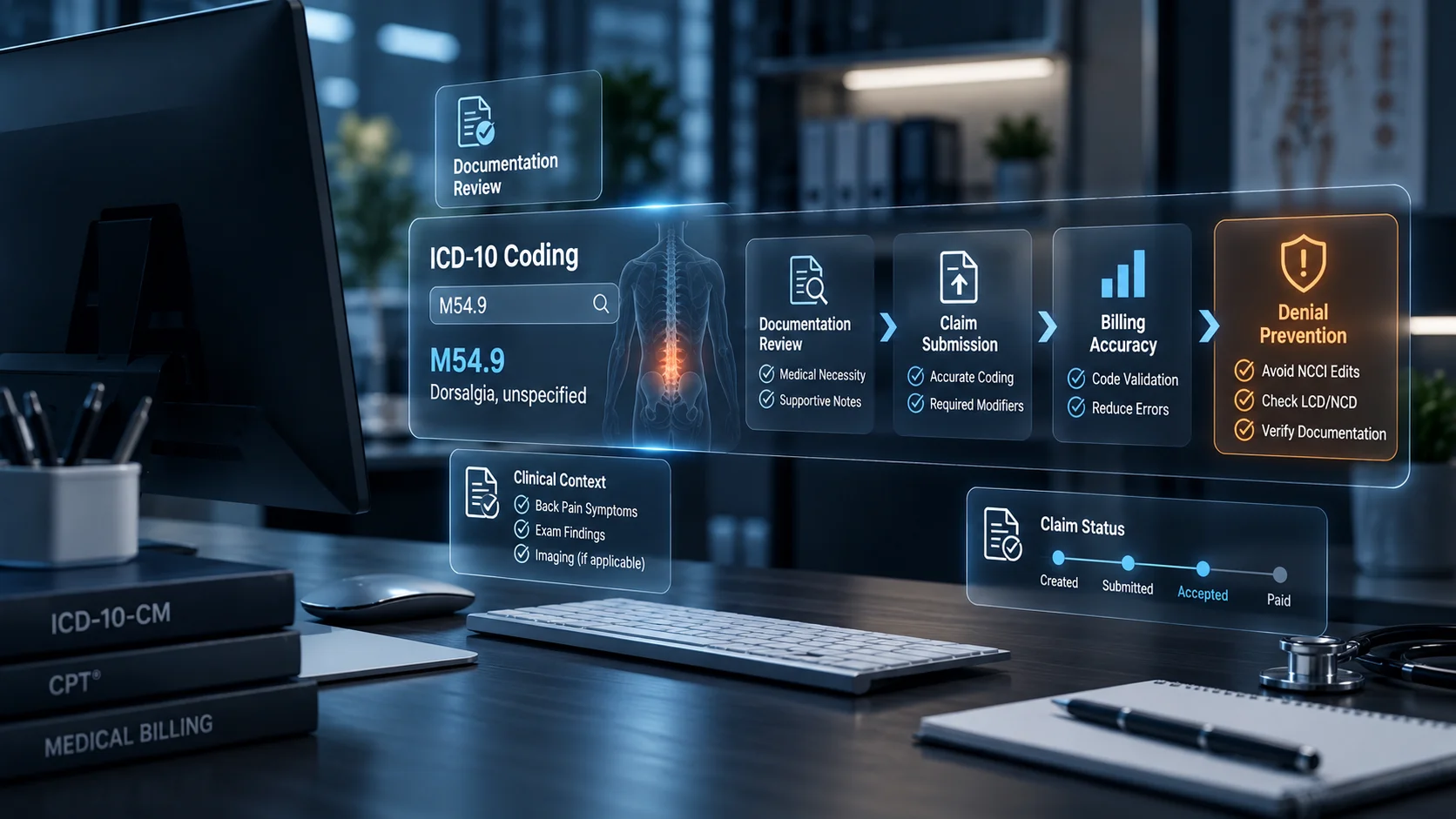
If you run or manage a neurology practice, you already know that billing here doesn’t work like billing for a family medicine office. A single patient visit can involve a detailed evaluation and management (E/M) note, an EEG or EMG/NCS study, an infusion or injectable drug, and coordination with neurosurgery or rehab — all in one encounter. Every one of those pieces has its own coding rules, its own documentation requirements, and its own way of getting denied if something is off.
That’s why, in 2026, neurology billing isn’t something a general biller can just pick up along the way. It takes specialty-specific knowledge to get paid correctly and on time.
Neurology Coding Has Layers Most Specialties Don’t
Most physician billing revolves around a visit code and maybe one or two add-ons. Neurology is different. A single encounter often stacks several types of services together:
- A high-complexity E/M visit (often 99205 or 99215), because patients frequently present with more than one chronic condition, complicated medication regimens, and test results that need independent physician interpretation
- Electrodiagnostic testing, such as nerve conduction studies and needle EMG across multiple limbs
- Extended EEG monitoring for seizure workups
- Injectable or infused medications, especially for MS, migraine, and neuromuscular disease
- Chemodenervation (Botox-type) injections for spasticity, dystonia, or chronic migraine
Each of these has separate CPT logic, its own coverage rules, and its own documentation checklist. Miss one piece — say, a missing interpretation report for an EEG, or the wrong modifier when an E/M and a procedure happen the same day — and it can hold up payment for the entire visit, not just that one line item.
2026 Brought Real Coding Changes, Not Just Updates on Paper
This year isn’t a “business as usual” year for neurology coding. The AMA rolled out CPT revisions effective January 2026 that changed how several neurology services are reported, including updates to EEG coding and the nerve conduction study code family. Practices that didn’t update their charge capture systems before those changes took effect may still be billing under descriptors that no longer match current codes — which shows up later as denials and, potentially, compliance exposure.
On top of that, coding for certain conditions has moved toward more specific subcategory codes instead of older, broader codes, which affects both accuracy and prior authorization. Add in that every Medicare Administrative Contractor keeps its own active Local Coverage Determination for EMG and nerve conduction studies, and it’s easy to see how a biller unfamiliar with neurology can miss requirements that vary from one MAC to another.
Prior Authorization Is a Bigger Bottleneck Than Ever
Neurology relies heavily on high-cost diagnostics and therapies — MRI of the brain and spine, EEG, EMG/NCS, and infusion therapy for MS and neuromuscular conditions. Nearly all of these require prior authorization from commercial payers and Medicare Advantage plans, and the specific requirements have shifted noticeably over the past few years.
Procedures like lumbar puncture and deep brain stimulation implantation also typically need authorization before the service is performed. Skip a step, or submit for the wrong authorization category, and the claim can be denied even though the care itself was completely appropriate. Recovering that revenue after the fact is far harder than getting the authorization right the first time.
Telehealth Coverage Rules Keep Shifting
Neurology has one of the highest shares of patients for whom in-person visits are genuinely difficult — people with mobility limitations, cognitive impairment, or conditions that make travel to the office a real burden. That makes telehealth coverage policy more consequential here than in many other specialties.
The problem is that telehealth rules for 2026 aren’t uniform. Some services are covered under permanent Medicare authority, others under extended temporary authority, and some have reverted to in-person-only coverage. Billing a telehealth visit under a category that has expired is a claim denial that’s difficult to reverse, simply because the service has already been delivered and can’t be “redone” in person after the fact.
Modifiers Are Where Neurology Claims Quietly Fall Apart
Modifier errors are one of the most common — and most avoidable — sources of lost revenue in neurology billing. A few examples that come up constantly:
- Modifier 25, needed when a significant, separately identifiable E/M service is billed alongside a procedure on the same day
- Modifier 26 vs. TC, which separates the professional interpretation of a neuroimaging or neurodiagnostic study from the technical component of performing it
- Bundling edits between EEG and EMG codes, which need to be checked against current National Correct Coding Initiative (NCCI) pairs before submission
These aren’t complicated once you know the pattern — but they require someone who bills neurology regularly enough to catch them automatically, rather than someone learning the specialty’s quirks claim by claim.
Documentation Has to Support the Level of Work Actually Done
One theme comes up again and again in neurology billing: the visits are complex, but the documentation often doesn’t fully reflect that complexity. When a neurologist manages multiple chronic conditions, interprets advanced imaging independently, and makes high-risk treatment decisions, that visit may genuinely qualify for a higher-level E/M code. But if the note doesn’t clearly capture the time spent or the medical decision-making involved, the claim gets coded — and paid — as something less than what actually happened.
This is exactly the kind of gap that a billing team with neurology-specific experience is trained to catch before the claim goes out, not after a denial comes back.
Conclusion
Neurology sits at a genuinely difficult intersection of medicine: chronic, progressive conditions; expensive diagnostics and therapies; frequent prior authorization requirements; and a coding structure that changes more often than most practices can track on their own. General billing knowledge isn’t enough to keep up with all of it.
Practices that treat neurology billing as its own specialty — with staff who understand EEG and EMG coding, current CMS updates, payer-specific authorization rules, and the documentation standards behind high-complexity E/M coding — are the ones that protect their revenue and avoid the slow bleed of preventable denials.
If your practice is spending more time chasing denials than seeing patients, it may be time to work with a billing partner who actually understands neurology’s coding structure inside and out. Get in touch with Kaizen Systems to see how specialty-focused billing support can improve your collections and reduce administrative strain.