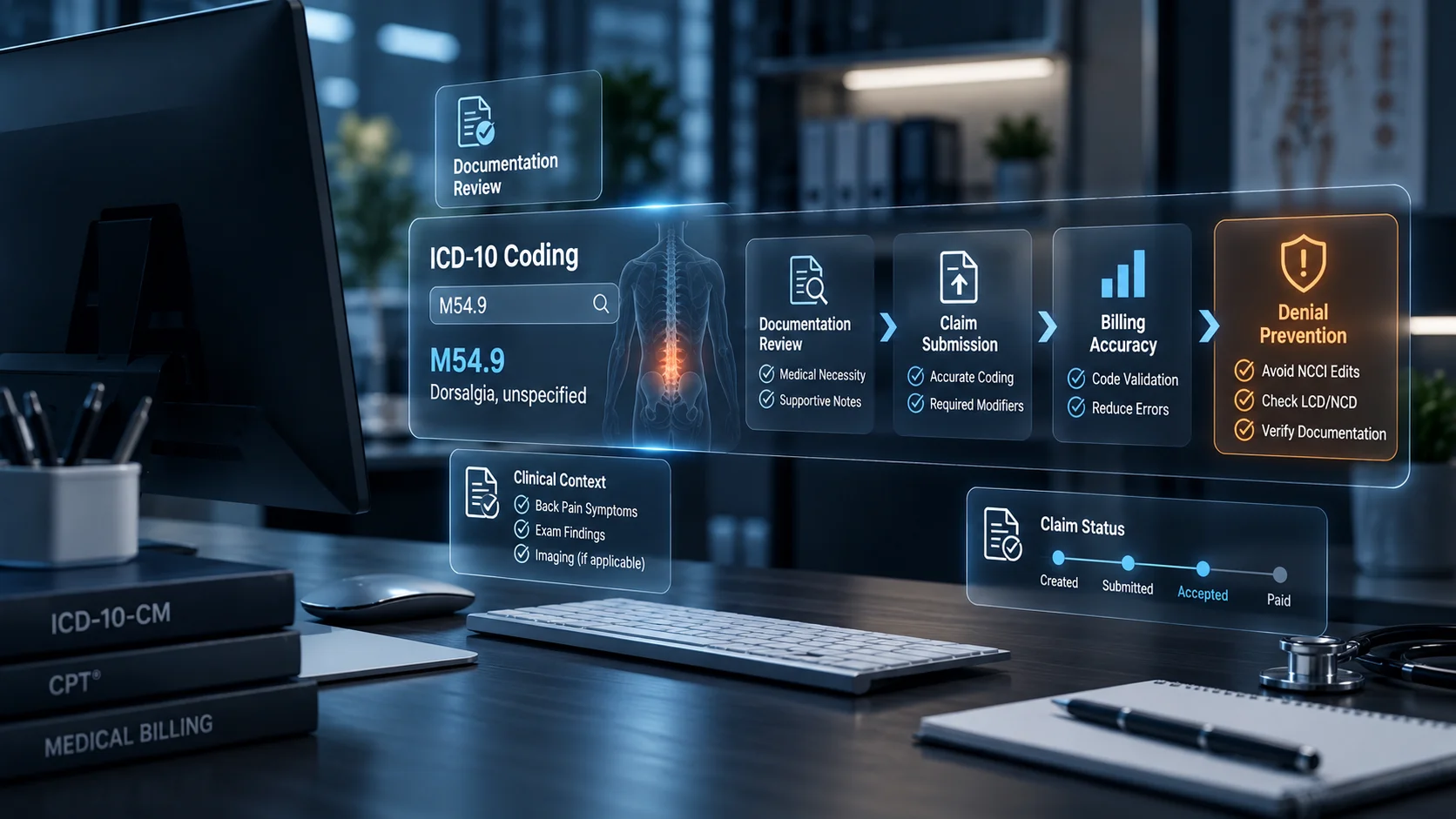
Back pain is a common reason patients seek medical care, but documenting the complaint correctly is only the first step. Healthcare providers must also ensure that the diagnosis code accurately reflects the information recorded in the medical chart. The ICD-10-CM code M54.9, Dorsalgia, unspecified, is used to classify back pain when the documentation does not identify a more specific type or location. Although it is a straightforward code, using it correctly requires attention to clinical documentation, coding guidelines, and billing requirements.
For healthcare providers, medical coders, and billing teams, understanding M54.9 can help improve coding consistency, reduce avoidable claim issues, and maintain reliable patient records. In this guide, Kaizen System explores the meaning of M54.9, when it is appropriate, common coding mistakes, and practical ways to strengthen the medical billing process.
What Is ICD-10 Code M54.9?
M54.9 is the ICD-10-CM code for dorsalgia, unspecified. Dorsalgia is a medical term for back pain, while unspecified indicates that the documentation does not provide enough detail to classify the pain more precisely. For example, a patient may report back discomfort during an office visit. The provider evaluates the patient and documents back pain, but the record does not identify the affected spinal region or establish a more specific diagnosis. In this situation, M54.9 may be appropriate.
However, this code does not identify the cause of the pain, confirm an underlying spinal condition, or indicate whether the pain is acute or chronic. The central coding principle is simple: the diagnosis code should reflect the provider’s documented assessment, not an assumption about the patient’s condition.
When Should Providers Use M54.9?
Providers and coding professionals should consider M54.9 when the medical record supports a diagnosis of back pain but lacks the detail needed for a more specific code.
Common examples include:
- The provider documents back pain without identifying the affected region.
- The patient’s complaint is recorded as nonspecific back discomfort.
- The evaluation identifies back pain, but no more specific diagnosis is established during that encounter.
Consider a patient who visits a clinic complaining of back pain after several days of discomfort. The provider documents the symptom but does not specify whether it affects the cervical, thoracic, or lumbar region. If no additional information supports a more specific classification, M54.9 may be suitable.
Now consider a patient whose medical record clearly identifies pain in the lower back. In that case, the coding team should evaluate whether M54.50, Low back pain, unspecified, is more appropriate.
This distinction matters because unspecified coding should reflect the available documentation rather than replace a more precise diagnosis.
M54.9 vs. Other Back Pain ICD-10 Codes
Not all back pain diagnoses should be coded the same way. Selecting the appropriate code depends on the location and nature of the documented condition.
| ICD-10-CM code | Description |
| M54.9 | Dorsalgia, unspecified |
| M54.2 | Cervicalgia, or neck pain |
| M54.6 | Pain in thoracic spine |
| M54.50 | Low back pain, unspecified |
| M54.51 | Vertebrogenic low back pain |
| M54.41 | Lumbago with sciatica, right side |
These codes represent different clinical descriptions and should not be used interchangeably.
For instance, M54.51 identifies vertebrogenic low back pain, which is more specific than a general complaint of back pain. M54.41 describes low back pain with right-sided sciatica and requires supporting documentation.
When choosing a code, coders should review the complete clinical record and consult the official ICD-10-CM Alphabetic Index, Tabular List, and applicable coding guidelines.
Why Clinical Documentation Matters for M54.9
Accurate coding begins with clear clinical documentation. When a medical record contains only a brief statement such as “back pain,” it may not provide enough information to determine whether a more specific code is appropriate.
Useful documentation may include:
- The location of the pain, when known.
- The patient’s description of the symptoms.
- Relevant examination findings.
- The provider’s assessment and established diagnosis.
- Duration, associated symptoms, and other clinically relevant details.
Not every encounter requires every detail. Documentation should be appropriate to the patient’s condition and the services provided.
If the record appears incomplete, coding professionals should follow organizational procedures for clarification and provider queries. They should never independently assume the location, cause, or severity of the patient’s pain.
Better documentation helps create a clearer connection between the clinical encounter, the diagnosis code, and the services billed.
Common M54.9 Coding Mistakes to Avoid
Even experienced healthcare teams can encounter documentation and coding problems. Several mistakes deserve particular attention.
1. Using M54.9 For Every Back Pain Complaint
When the provider documents a specific spinal region or a more precise diagnosis, the coding team should evaluate the corresponding code instead of automatically selecting M54.9.
2. Assuming An Underlying Condition
Back pain does not automatically mean a patient has a herniated disc, radiculopathy, or another spinal disorder. Such diagnoses require appropriate clinical documentation.
3. Confusing Unspecified Back Pain With Chronic Back Pain
M54.9 does not independently establish chronicity. If the duration or chronic nature of pain is relevant, the provider should document it appropriately, and the coding team should apply the applicable rules.
4. Overlooking Annual Code Updates
ICD-10-CM codes and official guidance may change between fiscal years. Healthcare organizations should verify the applicable code set for the date of service rather than rely entirely on older references.
How Accurate M54.9 Coding Supports Medical Billing
Diagnosis coding is an important part of the medical billing process. Inaccurate or incomplete coding can lead to claim questions, rework, delayed processing, or denials, depending on the circumstances and payer requirements.
For example, if a provider documents a specific diagnosis but the submitted claim uses an overly broad code, the discrepancy may require review. Similarly, a medical record that lacks necessary detail can make it harder for billing teams to demonstrate that the selected code reflects the encounter. Healthcare organizations can strengthen their processes by introducing practical checks before claim submission.
These may include reviewing diagnosis-code consistency, identifying missing documentation, maintaining current coding references, and tracking recurring claim issues. Regular feedback between providers, coding professionals, and billing teams can also help prevent repeated errors.
The goal is not simply to avoid denials. It is to create a reliable process in which clinical records and submitted claims accurately represent the care provided.
How Kaizen System Can Help Healthcare Teams Improve Coding Workflows
At Kaizen System, continuous improvement is a useful principle for strengthening healthcare administrative processes. When applied to medical billing, it means identifying recurring problems, understanding their causes, and improving the workflow step by step.
For practices managing back pain diagnoses, a structured review process can help teams identify when unspecified codes are appropriate and when additional documentation may be needed.
Practical improvement measures include:
- Documentation reviews: Identify recurring gaps in diagnosis descriptions.
- Coding quality checks: Compare selected codes with provider documentation.
- Staff education: Help providers and coding teams understand relevant code distinctions.
- Claim monitoring: Track recurring coding-related rework and denial patterns.
- Workflow improvement: Use review findings to refine procedures and communication.
These measures should be adapted to the organization’s size, services, payer requirements, and existing systems. They can support more consistent work without encouraging unnecessary documentation or inappropriate code selection.