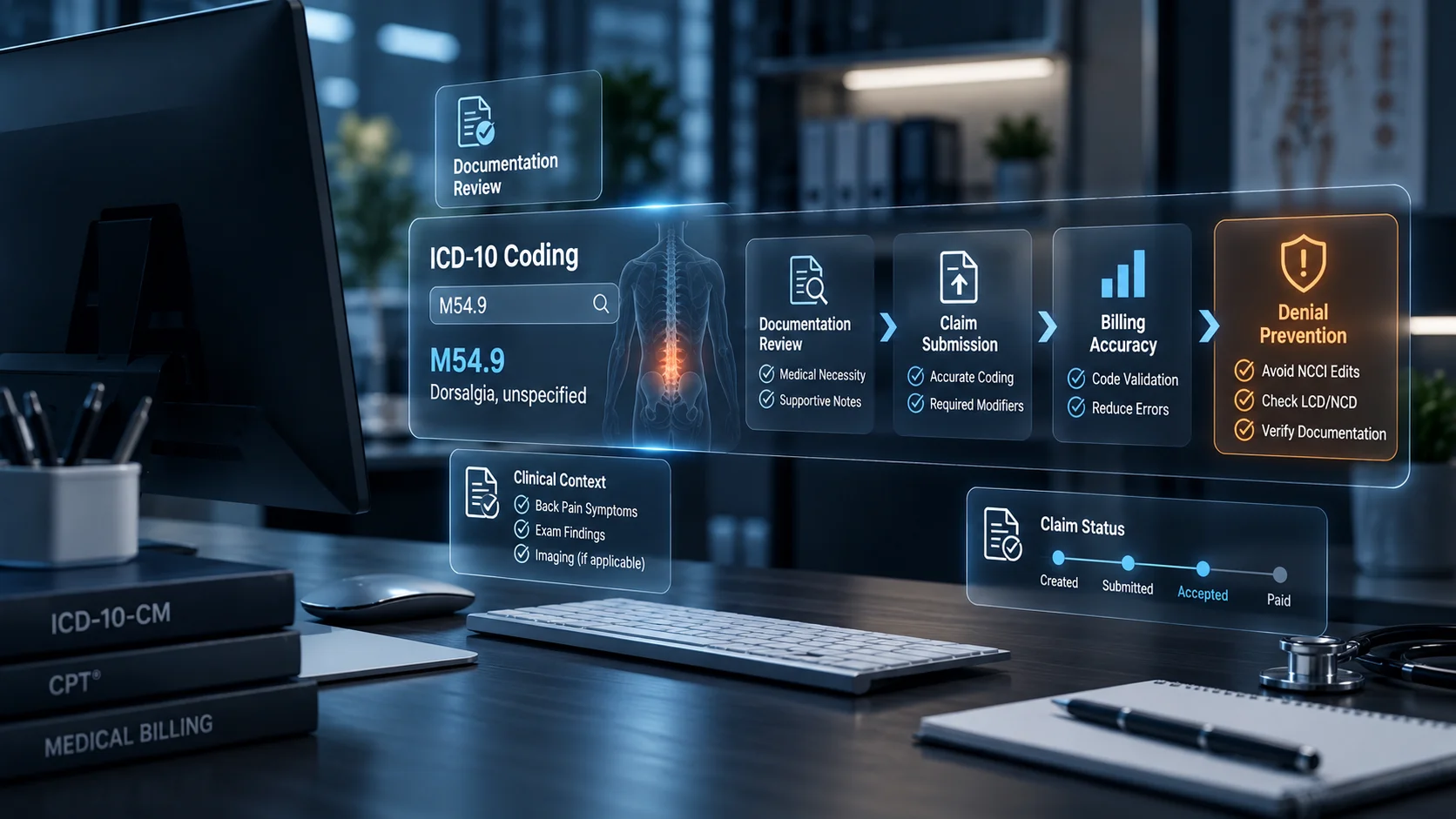
Back pain is a routine complaint in medical practices. A patient may come in with a few days of discomfort, ongoing pain, stiffness, or pain that makes everyday activities difficult. But while back pain is common, coding it correctly is not always as simple as it sounds. One ICD-10-CM code that often comes up is M54.9, Dorsalgia, unspecified. It can be used when the medical record identifies back pain but does not provide enough detail to assign a more specific diagnosis. For providers and medical billing teams, the important question is not simply, “Can we use M54.9?” It is “Does the documentation actually support M54.9, or is there a more specific code available?”
Let’s break it down in simple terms.
What Does M54.9 Mean?
M54.9 is the ICD-10-CM code for Dorsalgia, unspecified. In everyday language, dorsalgia refers to pain in the back or spine. The word “unspecified” is important. It generally means the documentation does not identify the exact type or location of the back pain well enough to use a more specific code.
For example, a medical note may say:
“The patient presents with back pain.”
If no additional information identifies the specific spinal region or another related diagnosis, M54.9 may be considered. But if the provider documents low back pain, thoracic spine pain, cervical pain, or sciatica, a more specific code may be appropriate.
That distinction can make a real difference in coding accuracy.
When Should Providers Consider M54.9?
M54.9 may be appropriate when the patient’s condition is documented simply as back pain or dorsalgia without further clinical specificity. Imagine a patient visiting a primary care practice complaining of back discomfort. After examination, the provider documents “unspecified back pain” but does not identify a specific anatomical location or underlying condition. In that situation, M54.9 may accurately reflect what is documented. The key is not to add information that isn’t in the medical record.
A coder should not automatically assume that “back pain” means lumbar pain. Likewise, the coder should not assume that the patient has sciatica simply because the patient describes discomfort in the back.
The code should represent the provider’s documented diagnosis.
Is M54.9 the Same as Low Back Pain?
No. This is an important distinction. Many people use “back pain” and “low back pain” as if they mean the same thing, but ICD-10-CM provides more specific options for different types and locations of pain. For example, M54.50 represents low back pain, unspecified, while M54.51 represents vertebrogenic low back pain. There are also separate codes for thoracic spine pain, cervicalgia, and sciatica.
So, if a provider documents:
“Patient has low back pain,”
the documentation may support a more specific low-back-pain code rather than M54.9.
On the other hand, if the record only says:
“Patient has back pain,”
without identifying the location, M54.9 may be more appropriate.
This is why reviewing the actual clinical documentation matters.
What Should Providers Document?
Providers don’t need to write a long paragraph just to make coding easier. However, when clinically relevant, a few details can make the record much clearer.
Consider documenting:
- Where the pain is located
- How long the patient has experienced the pain
- Whether the pain radiates
- Relevant symptoms associated with the pain
- Important examination findings
- Any known underlying condition
- Relevant imaging or test results
- The final clinical assessment
For example, compare these two notes:
Less specific:
“The patient reports back pain.”
More informative:
“The patient reports persistent low back pain for three weeks with intermittent pain extending into the right leg.”
The second note gives the coding team substantially more clinical information to work with. Of course, documentation should always reflect the actual clinical encounter rather than being written solely to obtain a particular code.
Common Back Pain Codes to Know
M54.9 is only one code within the broader group of back and spinal pain diagnoses.
Some related ICD-10-CM codes include:
| Code | Description |
| M54.9 | Dorsalgia, unspecified |
| M54.50 | Low back pain, unspecified |
| M54.51 | Vertebrogenic low back pain |
| M54.59 | Other low back pain |
| M54.6 | Pain in thoracic spine |
| M54.2 | Cervicalgia |
| M54.31 | Sciatica, right side |
| M54.32 | Sciatica, left side |
These examples show why simply searching for “back pain” and choosing the first code that appears can lead to problems.
The correct code depends on what the provider actually documented and the coding rules applicable to the encounter.
Common M54.9 Coding Mistakes
One of the most common problems is using an unspecified code when the documentation supports something more specific.
For example, if the provider clearly documents lumbar pain, the billing team should review whether a low-back-pain code is more appropriate.
Another mistake is making assumptions.
A patient saying, “My back hurts,” does not automatically mean the pain is in the lower back. Similarly, pain traveling into the leg does not automatically mean the provider diagnosed sciatica.
There is also a risk in going in the opposite direction—choosing a highly specific diagnosis that the provider never documented.
Good coding sits between these two problems: don’t miss supported details, but don’t invent them either.
Why Accurate Back Pain Coding Matters
It may seem like choosing between two similar diagnosis codes is a small issue. In medical billing, however, small coding mistakes can create larger administrative problems.
Incorrect or unsupported diagnosis coding may contribute to:
- Claim rejections or denials
- Additional documentation requests
- Delayed reimbursement
- Claim corrections
- Coding audits
- Confusion between the clinical record and submitted claim
Accurate coding also creates a clearer picture of the patient’s encounter.
For healthcare organizations, this is particularly important when billing teams handle a large number of claims every month. A small recurring coding issue can become much more significant when repeated across hundreds of encounters.
A Simple M54.9 Documentation Checklist
Before submitting a claim involving M54.9, providers and billing teams can ask a few straightforward questions:
Is Back Pain Actually Documented?
The diagnosis should be supported by the medical record.
Is The Location Known?
Check whether the provider identifies cervical, thoracic, lumbar, or another region.
Is There A More Specific Diagnosis?
Look for documented conditions such as sciatica or a specific type of low back pain.
Are We Making Assumptions?
Don’t turn a general symptom into a more specific diagnosis without documentation.
Are We Using The Correct Icd-10-Cm Code Set?
Coding requirements can change, so billing teams should work with the code set applicable to the date of service.
This quick review can help catch avoidable errors before a claim goes to the payer.
How Better Coding Supports Your Revenue Cycle
Back pain coding is just one small part of the larger medical billing process. When documentation, coding, claim submission, and follow-up work together, practices are in a better position to keep their revenue cycle moving smoothly.
A strong billing process does not focus only on submitting claims. It also looks at why claims are being denied, where documentation problems occur, whether coding patterns are consistent, and where revenue may be getting lost.
For busy practices, having experienced billing and coding professionals review these areas can reduce administrative pressure and help staff spend more time on patient care.
How Kaizen Supports Healthcare Providers
At Kaizen, medical billing and revenue cycle management are approached as more than simple claim submission. The goal is to help healthcare organizations manage the financial side of their practice with greater consistency.
From medical coding and billing to denial management, credentialing, and revenue cycle support, the right processes can help providers identify billing issues and improve their overall workflow.
For practices dealing with recurring coding questions, claim denials, or administrative bottlenecks, professional billing support can provide another layer of review and accountability.
Final Thoughts on M54.9
M54.9 — Dorsalgia, unspecified, can be useful when a patient’s medical record documents back pain but does not provide enough detail to support a more specific diagnosis.
However, it should not be treated as the automatic code for every back-pain visit.
The best approach is straightforward: document what you actually find, review the entire medical record, and use the most appropriate code supported by the documentation and current ICD-10-CM guidelines. For providers and billing teams, better documentation and careful code selection can make the claims process cleaner and help prevent avoidable billing problems.
If your practice needs help managing medical billing, coding, denials, or the broader revenue cycle, Kaizen can help you build a more organized and reliable billing process. Visit Kaizen to learn more about its healthcare revenue cycle solutions.