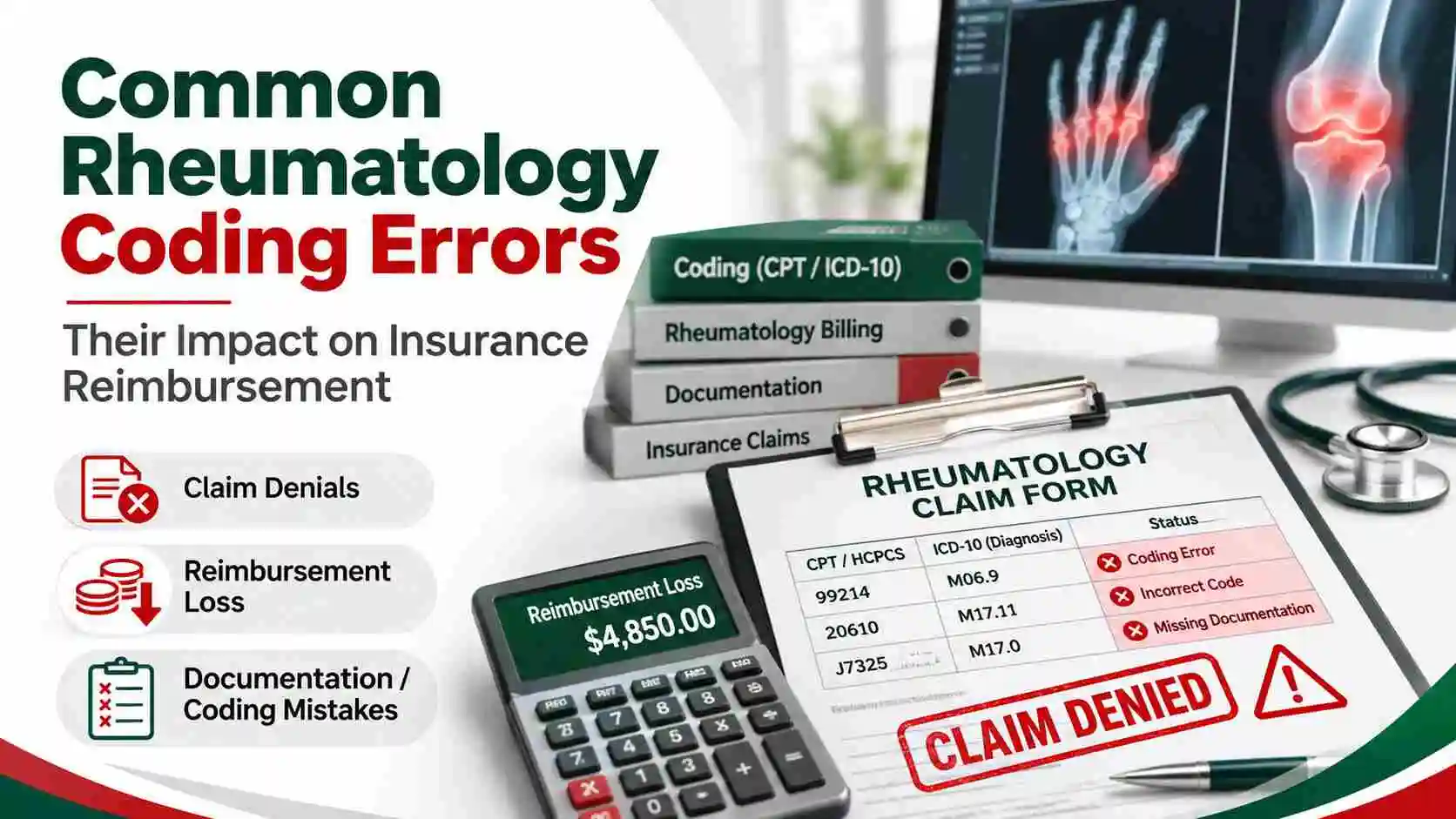
Accurate medical coding is essential for maintaining a healthy revenue cycle in rheumatology practices. From diagnosing rheumatoid arthritis and lupus to managing chronic inflammatory conditions and administering biologic therapies, rheumatologists handle complex cases that require detailed clinical documentation and precise billing practices. Even minor coding mistakes can lead to insurance claim denials, delayed reimbursements, compliance concerns, and unnecessary administrative expenses. Rheumatology coding errors are particularly challenging because many conditions share similar symptoms but require different diagnosis codes, documentation, and treatment considerations. Additionally, infusion procedures, medication administration, and ongoing disease management introduce further billing complexities.
Understanding common coding mistakes and their financial consequences can help healthcare providers improve claim accuracy and protect practice revenue. This article explores frequent rheumatology billing and coding errors, their impact on insurance reimbursement, and practical strategies for preventing them.
1. Common Rheumatology Coding Errors That Affect Reimbursement
Rheumatology practices must follow accurate ICD-10-CM, CPT, and HCPCS coding requirements. The following mistakes frequently create reimbursement challenges.
1.1 Incorrect Or Unspecified Icd-10-Cm Diagnosis Codes
One of the most common rheumatology coding errors involves selecting an incorrect or insufficiently specific diagnosis code.
Conditions such as rheumatoid arthritis, psoriatic arthritis, osteoarthritis, and systemic lupus erythematosus have distinct coding requirements. Selecting a general diagnosis code when the medical record supports greater specificity can affect claim processing and medical necessity reviews.
For example, rheumatoid arthritis coding may require details about the affected joints, laterality, and disease manifestations, depending on the applicable code.
How it affects reimbursement: Incorrect diagnosis codes can trigger medical necessity denials, create inconsistencies with treatment authorization requirements, or delay claim approval.
How to prevent it: Coding professionals should review the physician’s documentation, verify codes using the official ICD-10-CM Alphabetic Index and Tabular List, and select the highest supported level of specificity.
1.2 Missing Documentation For Medical Necessity
Insurance companies need sufficient clinical information to establish that a service or treatment is medically necessary.
Rheumatology treatments, particularly biologic medications and infusion therapies, often require supporting documentation. This may include the patient’s diagnosis, treatment history, clinical findings, previous medication response, and relevant laboratory results.
When documentation does not adequately support the billed service, insurers may request additional records or deny reimbursement.
How it affects reimbursement: Incomplete documentation can result in medical necessity denials, delayed payments, and additional administrative work.
How to prevent it: Maintain comprehensive clinical records that clearly connect the patient’s diagnosis, symptoms, treatment plan, and services provided. Verify payer-specific medical necessity and prior authorization requirements before treatment.
1.3 Incorrect Cpt And Hcpcs Codes For Infusion Services
Infusion and injection billing is an important part of rheumatology revenue cycle management. Practices administering medications such as biologic therapies must correctly report drug codes and administration services.
Common mistakes include:
- Reporting incorrect drug-specific HCPCS codes.
- Using incorrect dosage units.
- Selecting the wrong infusion administration code.
- Billing services that are already included in another reported service.
- Failing to document infusion start and stop times when required by the applicable coding rules.
For example, billing an incorrect number of units for a biologic medication can create discrepancies between the administered dosage, medical record, and insurance claim.
How it affects reimbursement: Incorrect drug or administration coding may result in underpayment, overpayment, claim rejection, or compliance concerns.
How to prevent it: Reconcile medication records, vial quantities, administered dosages, and HCPCS billing units before submitting claims. Review current CPT and HCPCS guidance and payer-specific policies.
1.4 Incorrect Use Of Modifiers
Modifiers provide additional information about the services performed. Incorrect or missing modifiers can affect how insurance companies process rheumatology claims.
For example, modifier 25 may be appropriate when a significant, separately identifiable evaluation and management (E/M) service is performed on the same day as another procedure or service.
However, simply appending modifier 25 to every office visit involving an injection or infusion does not establish eligibility for separate payment. The documentation must support the distinct E/M service.
Similarly, modifiers JW and JZ have specific Medicare reporting requirements for eligible drugs from single-dose containers or single-use packages.
How it affects reimbursement: Incorrect modifier usage can trigger coding edits, claim denials, payment reductions, or additional scrutiny.
How to prevent it: Train billing staff on modifier requirements and review CMS guidance, CPT instructions, and individual payer policies regularly.
1.5 Incorrect Laterality And Anatomical Site Coding
Many musculoskeletal diagnosis codes require specific information about the affected anatomical site and side of the body.
For example, documentation describing arthritis in the right wrist should not automatically be coded as a left-sided or unspecified condition when the appropriate right-sided code is available.
Other mistakes include overlooking multiple affected joints or selecting a code that does not accurately represent the documented disease location.
How it affects reimbursement: Incorrect anatomical coding can create inconsistencies between clinical documentation and submitted claims, potentially resulting in denials or requests for clarification.
How to prevent it: Ensure physicians document affected joints, anatomical locations, and laterality clearly. Coding professionals should verify the complete code using the current ICD-10-CM Tabular List.
2. How Rheumatology Coding Errors Impact Insurance Reimbursement
Coding inaccuracies affect more than individual claims. They can create financial and operational challenges throughout a medical practice.
Delayed Payments And Claim Denials
Incorrect diagnosis codes, missing modifiers, and incomplete documentation can prevent claims from passing payer edits. Denied claims require investigation, correction, and resubmission, increasing the time between service delivery and reimbursement.
Revenue Loss And Underpayments
Some errors result in claims being paid at a lower amount than the practice is entitled to receive. Incorrect drug units, omitted billable services, and overlooked reimbursement opportunities can contribute to significant revenue leakage over time.
Increased Administrative Costs
Every denied or incorrectly processed claim requires additional staff attention. Billing teams must review documentation, communicate with insurance companies, submit corrected claims, and monitor outstanding balances.
These activities reduce operational efficiency and take time away from other revenue cycle responsibilities.
Compliance And Audit Risks
Repeated coding inaccuracies can raise concerns during payer audits and compliance reviews. Incorrect coding may also result in overpayments that require investigation and repayment.
Maintaining accurate documentation and following official coding requirements helps practices reduce these risks.
3. Best Practices to Prevent Rheumatology Coding Errors
Preventing coding errors requires coordination between physicians, clinical staff, and billing professionals.
Consider implementing these strategies:
1. Conduct regular coding audits: Review submitted claims to identify recurring errors involving diagnosis codes, modifiers, infusion services, and medication units.
2. Provide continuous staff training: Keep coding and billing teams informed about annual ICD-10-CM updates, CPT changes, HCPCS revisions, and payer-specific requirements.
3. Improve clinical documentation: Encourage physicians to document diagnoses, disease manifestations, affected joints, treatment decisions, and medical necessity clearly.
4. Verify insurance coverage and authorization: Confirm patient eligibility, medication coverage, and prior authorization requirements before providing expensive treatments.
5. Use appropriate billing technology: Practice management systems and claim-scrubbing tools can help identify missing information, inconsistent codes, and potential billing errors before claim submission.
6. Monitor denial trends: Track denial reasons, reimbursement delays, and recurring coding problems. Use these findings to improve internal billing workflows.
4. How Kaizen Systems Supports Accurate Rheumatology Billing and Coding
Managing rheumatology billing and coding requires specialized knowledge, consistent documentation practices, and close attention to changing insurance requirements. For practices struggling with recurring denials or administrative inefficiencies, professional billing support can make a meaningful difference.
Kaizen Systems (kaizenus.com) is an experienced medical billing and revenue cycle management partner that can help healthcare practices strengthen their billing operations.
With professional medical billing and coding support, rheumatology practices can focus on several important areas:
- Coding accuracy: Supporting appropriate diagnosis and procedure code selection based on clinical documentation.
- Claims management: Reviewing claims for common errors before submission to reduce avoidable rejections and denials.
- Denial management: Identifying denial patterns, correcting billing issues, and supporting timely appeals when appropriate.
- Revenue cycle optimization: Improving claim follow-up, payment tracking, and accounts receivable management.
- Compliance support: Helping practices maintain consistent billing processes aligned with applicable coding guidelines and payer requirements.
Partnering with a knowledgeable medical billing provider allows rheumatologists to spend less time managing administrative challenges and more time focusing on patient care.
Conclusion
Rheumatology coding errors can have a direct impact on insurance reimbursement, practice revenue, and administrative efficiency. Incorrect diagnosis codes, incomplete medical necessity documentation, infusion billing mistakes, modifier misuse, and anatomical coding inaccuracies are among the most common challenges.
Preventing these problems requires accurate clinical documentation, ongoing coding education, regular claim audits, and effective denial management processes.
By strengthening their billing workflows and working with experienced revenue cycle professionals, rheumatology practices can reduce preventable claim denials, improve reimbursement accuracy, and maintain financial stability.
Kaizen Systems can support this process through professional medical billing and revenue cycle management services designed to improve operational efficiency and help healthcare practices maintain a healthier revenue cycle.