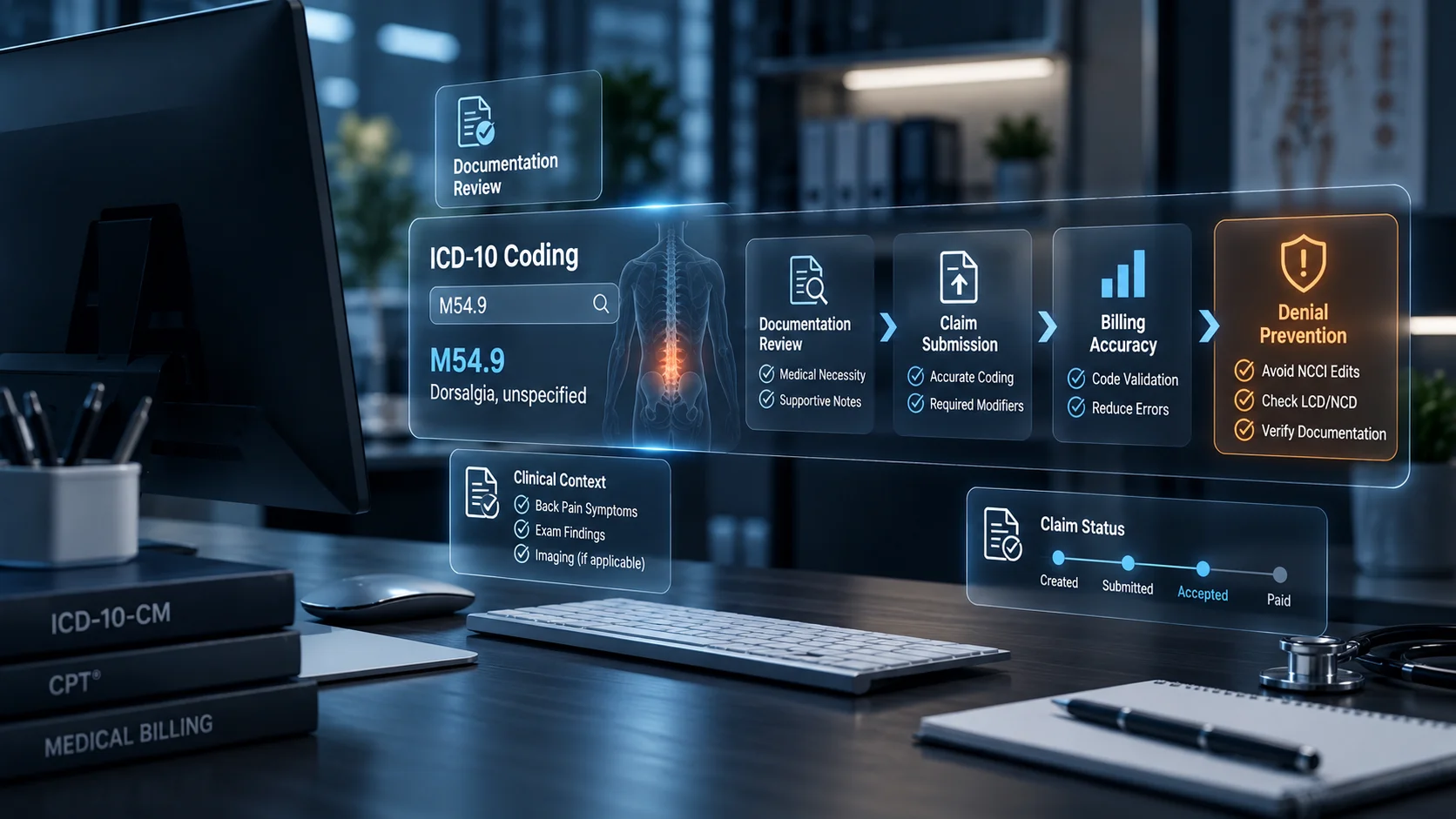
Artificial intelligence is no longer just a future idea in healthcare revenue cycle management (RCM). It is already being used by a large number of healthcare organizations to automate repetitive work, improve claims processing, identify billing problems, and support faster reimbursement.
But there is an important gap between using AI and getting measurable financial results from AI.
Recent Experian Health research found that 63% of healthcare providers have introduced AI into their RCM workflows, while only 15% have fully integrated AI into their standard RCM operations. Other industry research also shows that adoption is growing faster than organizations’ ability to prove ROI.
For medical practices and healthcare organizations, the real question is no longer simply, “Should we use AI?” It is:
How can we use AI in a way that actually improves revenue, reduces administrative work, and delivers measurable ROI?
What Is AI Revenue Cycle Management?
AI revenue cycle management means using artificial intelligence, machine learning, automation, and related technologies to improve different stages of the healthcare revenue cycle.
Traditional RCM depends heavily on employees manually checking eligibility, entering information, reviewing claims, following up on unpaid accounts, identifying denials, and preparing appeals. These tasks can consume significant time and are vulnerable to human error.
AI can assist with many of these processes by analyzing large amounts of information quickly and identifying patterns that may be difficult for a person to spot.
For example, AI-powered RCM tools can support:
- Patient eligibility verification
- Insurance and benefits checks
- Medical coding assistance
- Claim review and editing
- Denial prevention
- Claim status monitoring
- Prior authorization workflows
- Patient payment communication
- Accounts receivable analysis
- Underpayment identification
- Denial and appeal prioritization
The goal is not necessarily to remove humans from the revenue cycle. Instead, effective AI gives RCM teams better information and allows staff to spend more time on work that requires judgment.
Why Are 63% of Providers Adopting AI?
The growing adoption of AI is closely connected to the challenges healthcare organizations face today.
RCM teams are dealing with increasing administrative workloads, staffing pressures, complex payer requirements, claim denials, and delayed reimbursements. Guidehouse and HFMA’s 2026 research found that payer challenges remain a major concern, with 88% of surveyed executives ranking them among their top three revenue cycle problems.
AI can help organizations manage these challenges without simply adding more manual labor.
For example, instead of asking an employee to manually review thousands of claims, an AI system can analyze claims and flag those that appear likely to contain eligibility, coding, documentation, or other issues.
This allows the RCM team to focus its attention where it is most needed.
Why Has Only 15% Fully Integrated AI?
Adopting an AI tool is not the same as successfully integrating AI into an RCM operation.
Many organizations start with a small pilot. They may use AI for eligibility checks, claims analysis, coding support, or another limited task. However, moving from a pilot to a reliable, organization-wide workflow requires good data, system integration, staff training, governance, and clear performance measurements.
Experian Health reports that privacy, security, accuracy, and cost remain major barriers to wider AI adoption.
Healthcare organizations also need to consider how AI interacts with existing billing systems, EHRs, clearinghouses, payer portals, and internal processes.
If AI operates separately from the rest of the RCM workflow, its potential value can be limited.
Where AI Can Make the Biggest Difference in RCM
One of the most valuable opportunities is denial prevention.
Traditional denial management is often reactive. A claim is submitted, the payer rejects it, and then someone investigates the reason, corrects the issue, and submits it again.
AI allows organizations to move toward a more proactive approach.
Before a claim is submitted, AI can help identify patterns associated with previous denials. It may flag missing information, potential coding problems, eligibility concerns, or documentation issues.
That does not guarantee that every denial will disappear, but it can help RCM teams address preventable problems earlier.
AI is also being used for eligibility and patient access. These front-end processes are important because an error made before a patient’s visit can eventually become a billing or reimbursement problem.
AI Can Improve Staff Productivity, Too
Revenue cycle teams often spend hours on repetitive tasks that do not necessarily require complex decision-making.
AI and automation can take over or assist with some of this repetitive work.
For example, a system may automatically organize accounts by priority, identify claims requiring attention, summarize denial reasons, or provide information that an employee would otherwise need to collect manually.
This can reduce unnecessary administrative work and allow employees to concentrate on more complex cases.
Experian Health reports that organizations using AI are seeing benefits such as fewer denials and improved resubmission success, while AI and automation can also reduce administrative burden on healthcare staff.
Why AI Adoption Does Not Automatically Mean ROI
The 63% adoption figure sounds impressive, but adoption alone does not prove financial success.
A healthcare organization can purchase an AI platform and still fail to generate meaningful ROI if it does not measure the right outcomes.
Before implementing AI, organizations should establish a baseline.
Important measurements may include:
- Clean claim rate
- Initial denial rate
- Days in accounts receivable
- Net collection rate
- Cost to collect
- Claim turnaround time
- Appeal success rate
- Staff productivity
- Patient payment rate
After implementation, these metrics can be compared with the baseline.
This makes it easier to determine whether AI is actually improving the revenue cycle rather than simply adding another technology expense.
Human Oversight Still Matters
AI can process information quickly, but healthcare revenue cycle management involves financial, regulatory, and operational decisions that should not always be left to automation.
Human oversight remains important, particularly for complex claims, unusual payer requirements, coding questions, appeals, and situations where the available information is incomplete.
The strongest approach is often human-in-the-loop RCM.
AI identifies patterns, recommends actions, organizes information, and handles repetitive processes. Experienced RCM professionals review important decisions and take responsibility for cases that require judgment.
This combination can provide the efficiency of automation without removing the expertise of the people responsible for the revenue cycle.
How Healthcare Organizations Can Get More From AI
Organizations considering AI should avoid trying to automate everything at once.
A better approach is to start with a specific problem that can be measured.
For example, if claim denials are increasing, an organization could begin by analyzing denial patterns and identifying preventable causes. If eligibility errors are creating rework, patient access automation may be a better starting point.
The next step is to connect the technology to existing workflows and train staff to use it effectively.
Finally, organizations should continuously measure results.
AI should not be viewed as a one-time technology purchase. It should be treated as an ongoing RCM improvement strategy.
The Future of AI in Revenue Cycle Management
The healthcare industry is moving from AI experimentation toward broader operational use. Oliver Wyman’s 2026 RCM research found that roughly 20% to 40% of surveyed organizations reported broad or enterprise-wide AI use across parts of the revenue cycle, while 70% to 90% of decision-makers expected to increase spending on AI-enabled RCM capabilities over the following three years.
The future will likely involve more intelligent claims analysis, automated denial prevention, coding assistance, prior authorization support, payment optimization, and predictive revenue analytics.
However, the organizations that benefit most will not necessarily be those that adopt the most AI.
They will be the organizations that use AI to solve the right RCM problems, integrate it into existing workflows, maintain appropriate human oversight, and measure financial results carefully.
Final Thoughts: Turning AI Adoption Into Revenue Growth
The 63% AI adoption rate shows that healthcare RCM is changing quickly, but only 15% have fully integrated AI. The biggest opportunity is turning AI into measurable results.
AI can reduce repetitive work, prevent claim errors, improve denial management, and support faster reimbursements. However, technology works best when combined with experienced RCM professionals, accurate data, and strong workflows.
Explore Kaizen’s healthcare RCM solutions to improve billing accuracy, reduce denials, and strengthen your practice’s revenue cycle.