
If your practice bills Medicare, you’ve probably run into a situation where a service might not get paid. Maybe it happens too often, maybe it’s not medically justified on paper or maybe Medicare simply doesn’t cover it. In moments like this, one small form decides who pays the bill, the provider or the patient. That form is the Advance Beneficiary Notice of Noncoverage, better known as the ABN.
At Kaizen System, we see practices lose real revenue every month simply because an ABN was filled out incorrectly, signed at the wrong time or paired with the wrong modifier. This guide breaks down what an ABN actually is, when it’s required, how the modifiers work, and who ends up financially responsible when something goes wrong.
What Is An ABN?
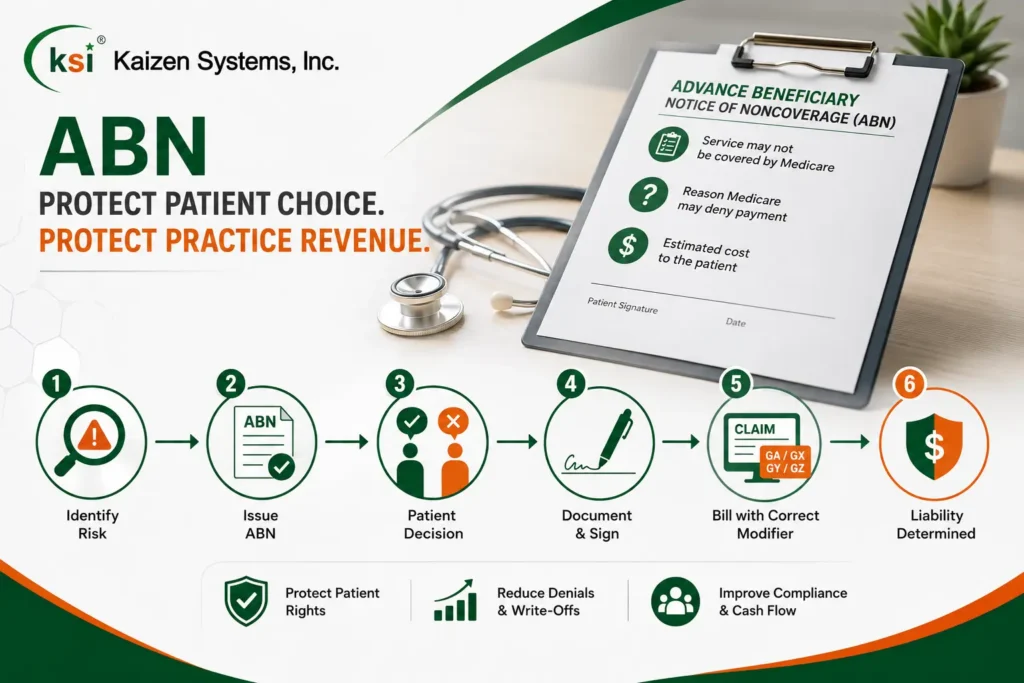
An ABN (Form CMS-R-131) is a written notice a provider gives to a Medicare beneficiary before delivering a service that Medicare may not pay for. It’s not a bill, and it’s not a rejection — it’s a heads-up. The form tells the patient three things:
- Which service might not be covered
- Why the provider believes Medicare may deny it
- An estimate of what the patient might owe if that happens
Once the patient reads this, they choose whether to move forward with the service and accept possible financial responsibility, or to decline it altogether. This choice is what legally allows a provider to bill the patient later if Medicare says no.
When Is An ABN Required?
An ABN applies only to Original Medicare (Part A and Part B). It cannot be used for Medicare Advantage or Medicare Part D plans — those have their own notice requirements.
Providers typically issue an ABN when they expect a denial because:
- The service exceeds Medicare’s frequency limits (for example, a lab test repeated too soon)
- The documentation doesn’t clearly support medical necessity
- The item or service falls into a gray area of coverage policy
On the other hand, if a service is never covered by Medicare under any circumstance — such as most cosmetic procedures — a mandatory ABN isn’t technically required, since the patient is automatically liable. Many practices still issue a voluntary notice anyway, simply to keep the patient informed and avoid billing disputes later.
Rules For A Valid ABN
An ABN only protects the practice if it’s done correctly. CMS is strict about the details, and auditors know exactly where to look. A valid ABN must be:
- Given before the service — never after the fact
- Specific, naming the exact service and the real reason denial is expected (generic wording like “may not be covered” doesn’t hold up)
- Signed and dated by the patient, or a documented refusal noted if they decline to sign
- Delivered in plain language the patient can reasonably understand
- Kept on file and produced if Medicare or an auditor requests it (it doesn’t need to be submitted with the claim itself)
A notice signed after the appointment, filled in vaguely, or missing the cost estimate is considered invalid — and an invalid ABN means the practice, not the patient, absorbs the cost of a denial.
The Modifiers: GA, GX, GY, GZ
Once the ABN situation is documented, the claim needs the correct modifier attached. This is where a lot of billing teams slip up, because the four modifiers look similar but mean very different things for liability.
| Modifier | Meaning | ABN Signed? | Who Pays if Denied? |
| GA | Provider expects denial for medical necessity and has a signed ABN on file | Yes | Patient |
| GZ | Provider expects denial for medical necessity but did NOT get a signed ABN | No | Provider |
| GY | Service is statutorily excluded — Medicare never covers it by law | Not required | Patient |
| GX | Voluntary ABN issued for a service that’s excluded from coverage | Yes (voluntary) | Patient |
A simple way to remember it: GA is protection, GZ is a confession. Appending GZ tells Medicare upfront that the practice knows it can’t collect from the patient, which avoids fraud flags but also guarantees a write-off.
GX and GY often go together — GY shows the service is excluded by law, while GX shows the patient was still given a courtesy notice about it.
Where Practices Lose Money
Most ABN-related revenue loss doesn’t come from Medicare’s rules being unclear — it comes from small process failures:
- Signing the ABN after the visit instead of before
- Using the wrong or expired version of Form CMS-R-131
- Leaving the estimated cost field blank
- Submitting GA when GZ should have been used (or vice versa)
- Billing a Qualified Medicare Beneficiary (QMB) patient directly, which is prohibited by federal law regardless of ABN status
Each of these turns a collectible claim into a forced write-off, or worse, creates compliance risk during an audit.
Building ABN Compliance Into Your Workflow
The practices that handle this well don’t treat the ABN as paperwork — they treat it as part of the clinical visit itself. That means:
- Training front-desk and clinical staff to recognize situations that call for an ABN
- Using current, unexpired CMS forms with the cost estimate always filled in
- Double-checking modifier selection against the ABN status before claims go out
- Verifying QMB status before attempting to collect any balance from a patient
A well-run ABN process protects the patient’s right to make an informed choice, and it protects the practice’s revenue when a service genuinely turns out to be non-covered.
Final Thought
An ABN is a small form with a big financial impact. Get the timing, wording, and modifier right, and a denied claim simply shifts to the patient as expected. Get any piece of it wrong, and the practice quietly eats the cost. For billing teams, mastering ABN rules isn’t optional — it’s one of the simplest ways to protect revenue that’s already been earned.
This article is for general informational purposes and does not constitute legal or billing compliance advice. Always refer to current CMS guidance for the most up-to-date requirements.