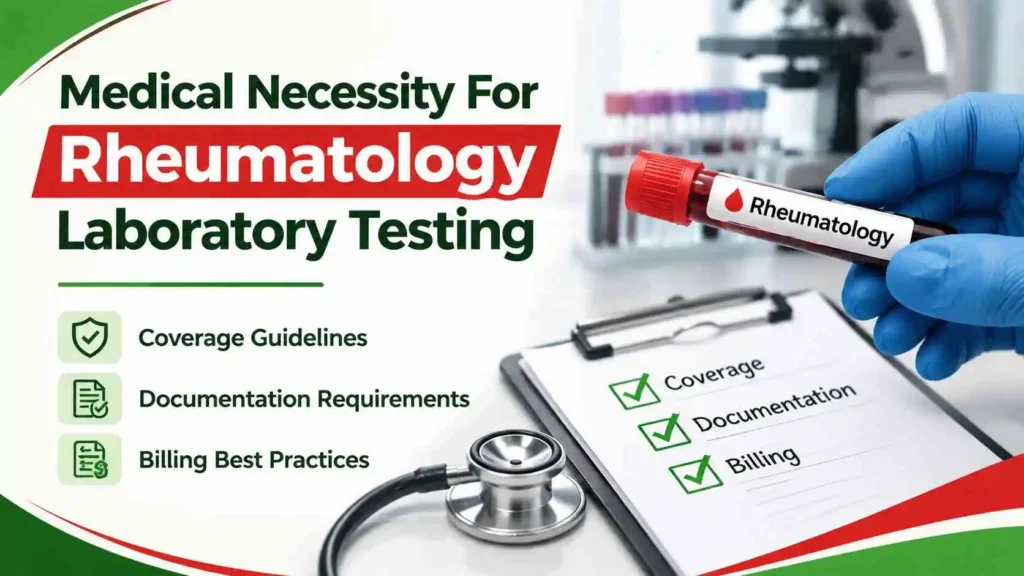
Rheumatology laboratory testing helps diagnose autoimmune conditions, monitor disease activity, and assess treatment safety. However, insurance coverage depends on whether each test meets medical necessity requirements and is supported by proper clinical documentation.
For rheumatology practices, understanding these requirements is essential for accurate coding, clean claim submission, and timely reimbursement. Common tests, including ANA, rheumatoid factor (RF), anti-CCP antibodies, and inflammatory markers, must be supported by appropriate clinical indications and diagnosis codes.
Medicare and commercial insurers review these factors when processing claims. Inadequate documentation or incorrect coding can lead to unnecessary denials and payment delays.
What Does Medical Necessity Mean In Rheumatology Laboratory Testing?
Medical necessity generally means that a healthcare service is reasonable and appropriate for diagnosing, evaluating, or treating a patient’s medical condition. For laboratory testing, the provider should have a clear clinical reason for ordering the test and should use the results to help manage the patient’s specific medical problem.
Under Medicare rules, diagnostic laboratory services must meet applicable reasonable-and-necessary requirements. CMS also expects documentation supporting the order and the clinical information provided to the laboratory.
CMS+1
In rheumatology, medical necessity may be established through:
- Signs and symptoms suggesting an autoimmune or inflammatory condition.
- Abnormal findings from a physical examination or previous laboratory tests.
- A suspected or established rheumatologic diagnosis requiring further evaluation.
- Disease activity assessment when clinically appropriate.
- Monitoring for potential medication-related complications.
- Changes in symptoms or clinical status that justify additional testing.
For example, ordering an ANA test for a patient with a suspected systemic autoimmune disease may be clinically appropriate when supported by relevant symptoms and examination findings. Ordering the same test as a routine screening measure for an otherwise asymptomatic patient may not meet the applicable coverage criteria.
The important distinction is that medical necessity depends on the patient’s individual clinical circumstances, not simply the name of the laboratory test.
Medical Necessity Requirements For Common Rheumatology Laboratory Tests
Different laboratory tests serve different clinical purposes. Their coverage depends on the reason for testing, supporting documentation, and the patient’s insurance policy.
1. Antinuclear Antibody (ANA) Testing
ANA testing helps evaluate suspected systemic autoimmune conditions, including lupus, Sjögren’s syndrome, and systemic sclerosis.
Documentation should explain the clinical suspicion behind the order. Relevant findings may include:
- Unexplained joint inflammation or persistent inflammatory symptoms.
- Photosensitive or characteristic skin rashes.
- Symptoms suggesting connective tissue disease.
- Other clinical findings that raise suspicion of systemic autoimmunity.
Routine ANA screening without relevant symptoms is generally discouraged. Repeat testing also requires careful consideration. ANA titers should not routinely be repeated simply to monitor disease activity.
2. Rheumatoid Factor (RF) and Anti-CCP Testing
RF and anti-cyclic citrullinated peptide (anti-CCP) tests help evaluate suspected rheumatoid arthritis (RA).
Clinical documentation may include persistent joint pain, swelling, morning stiffness, inflammatory arthritis findings, and examination results that support suspicion of RA.
Anti-CCP testing can provide useful diagnostic information, particularly during the evaluation of suspected early rheumatoid arthritis. However, a positive result alone does not establish the diagnosis.
Aetna and other commercial payers publish specific criteria for these tests. Some policies also limit repeat testing to situations involving persistent symptoms or new clinical findings.
Aetna+1
3. Erythrocyte Sedimentation Rate (ESR) and C-Reactive Protein (CRP)
ESR and CRP measure inflammation and can support the evaluation of inflammatory conditions.
Medical necessity may be supported by documentation of:
- Suspected inflammatory arthritis.
- Changes in disease activity.
- Unexplained systemic inflammatory symptoms.
- Treatment response or lack of response.
- Clinical findings requiring further investigation.
These markers are not specific to rheumatologic diseases. The provider should explain how the results will contribute to the patient’s evaluation or treatment plan.
4. Extractable Nuclear Antigen (ENA) and Anti-dsDNA Testing
ENA panels and anti-double-stranded DNA testing help investigate or evaluate particular autoimmune conditions.
For example, anti-dsDNA testing may be relevant when evaluating or monitoring established systemic lupus erythematosus (SLE). ENA testing may help investigate specific connective tissue diseases when clinical findings and previous ANA results support further evaluation.
Ordering broad autoimmune panels without a documented clinical indication can create unnecessary testing and coverage problems.
5. Complete Blood Count (CBC) and Comprehensive Metabolic Panel (CMP)
CBC and CMP testing are commonly used to assess general health, identify abnormalities, and monitor potential medication-related complications.
For patients receiving medications such as methotrexate, monitoring may include blood counts, liver function, and kidney function, depending on the medication and clinical circumstances.
The record should identify the medication being monitored, the purpose of testing, and any patient-specific factors that influence monitoring frequency.
How Clinical Documentation And Icd-10-Cm Codes Support Medical Necessity
Clinical documentation is one of the strongest ways to demonstrate that a rheumatology laboratory test was appropriate.
A diagnosis code alone may not explain why a particular test was ordered. The medical record should establish a clear connection between the patient’s condition, the provider’s clinical assessment, and the requested laboratory service.
Essential Documentation Elements
Rheumatology practices should ensure that the patient’s record includes:
- Relevant symptoms: Document joint pain, swelling, stiffness, fatigue, rashes, or other relevant clinical complaints.
- Examination findings: Include objective findings such as joint tenderness, synovitis, or restricted movement when present.
- Clinical assessment: Explain the suspected condition or established diagnosis being evaluated.
- Test justification: Record why each laboratory test is necessary.
- Treatment and monitoring plan: Explain how results will influence diagnosis, treatment decisions, or medication monitoring.
- Previous results: Reference relevant laboratory findings and explain why repeat testing is appropriate.
Choosing The Correct Icd-10-Cm Diagnosis Code
ICD-10-CM codes communicate the patient’s documented condition to the insurance payer. Selecting an appropriate code helps establish the relationship between the diagnosis and the laboratory procedure.
For example:
| Clinical condition | Potential ICD-10-CM code |
| Rheumatoid arthritis, unspecified | M06.9 |
| Systemic lupus erythematosus, unspecified | M32.9 |
| Other specified joint disorders | M25.80 |
| Polyarthralgia | M25.50 |
| Other fatigue | R53.83 |
These are examples, not guaranteed coverage approvals. Codes must match the provider’s documentation and current ICD-10-CM requirements.
Example: A patient reports joint swelling and prolonged morning stiffness. The rheumatologist orders RF and anti-CCP tests to investigate suspected rheumatoid arthritis. The medical record should document symptoms, examination findings, suspected diagnosis, and the reason for testing to support medical necessity.
Medicare And Commercial Insurance Coverage Requirements
Although the general principle of medical necessity applies across healthcare payers, coverage requirements are not identical.
Medicare Requirements
Original Medicare Part B covers diagnostic laboratory testing when applicable coverage requirements are satisfied. CMS requires the treating provider to order the test and document medical necessity in the patient’s medical record.
CMS guidance also identifies important documentation requirements, including:
- Evidence of the laboratory order.
- Information identifying the ordering provider.
- Documentation showing accurate order processing and claim submission.
- Diagnostic information supplied to the laboratory, including ICD-10-CM codes or narrative descriptions.
An authenticated medical record may support the provider’s intent to order specific tests under applicable Medicare order requirements.
CMS+1
Medicare Administrative Contractors (MACs) may also publish Local Coverage Determinations (LCDs) and associated billing articles. These documents can establish additional coverage criteria, diagnosis-code requirements, and frequency limitations within their applicable jurisdictions.
Practices should check the Medicare Coverage Database rather than assuming that one LCD applies nationwide.
Commercial Insurance Requirements
Commercial insurers establish their own medical policies, which may differ in covered indications, testing frequency, and acceptable diagnostic criteria.
For example, Aetna’s policy on selected rheumatic disease tests identifies anti-CCP testing for rheumatoid arthritis, HLA-B27 testing for certain spondyloarthritis-related diagnoses, and anti-dsDNA testing for SLE evaluation and management. It also identifies certain specialized biomarkers as experimental or unproven.
Aetna
Similarly, Anthem and Blue Cross plans publish criteria addressing ANA, RF, anti-CCP, and ENA testing. Some policies specify when repeat testing may be covered.
Therefore, billing teams should verify the patient’s actual plan requirements, applicable policy version, and authorization requirements before submitting claims.
Common Reasons Rheumatology Laboratory Claims Are Denied
Understanding common denial patterns helps practices identify problems before claims reach the payer.
| Denial reason | How to prevent it |
| Missing clinical documentation | Maintain complete, relevant medical records. |
| Incorrect or nonspecific diagnosis code | Verify ICD-10-CM coding against provider documentation. |
| Diagnosis does not support the test | Match the clinical indication to the laboratory service. |
| Unnecessary repeat testing | Review previous results and document clinical changes. |
| Routine screening without symptoms | Establish and document a valid diagnostic indication. |
| Missing or incomplete test order | Verify the ordering provider and specific tests requested. |
| Frequency limitations exceeded | Check payer policies and document the reason for additional testing. |
One particularly important issue is repeat testing. Reordering ANA or other autoimmune tests without a meaningful clinical reason can raise medical necessity concerns. Previous results should be reviewed before new orders are placed.
Practical Strategies To Prevent Medical Necessity Denials
Reducing rheumatology laboratory claim denials requires coordination between providers, clinical staff, and medical billing teams.
The following practices can help improve compliance and reimbursement.
1. Verify Insurance Coverage Before Testing
Check the patient’s insurance eligibility, laboratory benefits, applicable medical policies, and authorization requirements. Pay particular attention to specialized autoimmune panels and advanced biomarker tests.
2. Establish A Consistent Documentation Workflow
Use standardized documentation templates that prompt providers to record symptoms, examination findings, diagnostic reasoning, and the purpose of laboratory testing.
Templates should support clinical judgment rather than replace individualized documentation.
3. Review Previous Laboratory Results
Check existing records before ordering repeat tests. If a patient’s symptoms change or the disease progresses, document the clinical reason for repeating a test.
4. Conduct Regular Coding Audits
Review laboratory claims for incorrect ICD-10-CM codes, missing diagnoses, unsupported testing frequency, and mismatches between CPT codes and clinical documentation.
5. Monitor Denial Trends
Track medical necessity denials by payer, test type, diagnosis code, and denial reason. This information helps identify recurring problems and improve front-end billing processes.
6. Strengthen Provider And Billing Team Communication
Billing professionals should communicate documentation gaps to providers promptly. Providers should receive regular updates about payer policy changes and recurring denial patterns.
These steps can help practices improve first-pass claim accuracy, reduce avoidable rework, and maintain a more predictable revenue cycle.
How Rheumatology Practices Can Improve Billing Accuracy And Reimbursement
Rheumatology billing involves more than submitting laboratory codes and diagnosis information. Practices must coordinate clinical documentation, coding accuracy, payer compliance, claim submission, and denial management.
A well-organized revenue cycle management (RCM) process should include:
- Accurate CPT and ICD-10-CM code assignment.
- Verification of payer-specific laboratory coverage requirements.
- Review of medical necessity before claim submission.
- Proper documentation of laboratory orders.
- Timely claim follow-up and denial resolution.
- Regular reimbursement and denial analysis.
Working with an experienced medical billing partner can help rheumatology practices identify billing gaps and strengthen their revenue cycle processes.
Kaizen Systems supports healthcare providers with medical billing, coding, and revenue cycle management solutions. Its specialized Rheumatology Billing Services can be positioned as an internal resource for practices seeking support with rheumatology-specific billing challenges, accurate claim processing, and reimbursement management.
By combining accurate coding with complete clinical documentation and payer-policy awareness, practices can build a more reliable billing workflow while allowing providers to focus on patient care.
Conclusion
Understanding medical necessity requirements for rheumatology laboratory testing is essential for protecting reimbursement and maintaining compliant billing practices. Every laboratory claim should have a clear clinical purpose supported by appropriate documentation, accurate ICD-10-CM coding, and applicable payer coverage criteria.
From ANA and anti-CCP testing to inflammatory markers and medication monitoring, rheumatology practices must ensure that laboratory orders reflect each patient’s individual clinical needs.
Consistent documentation, insurance verification, coding audits, and proactive denial management can significantly strengthen the claims process.
Looking to improve your rheumatology billing and reduce preventable claim denials? Explore Kaizen Systems’ Rheumatology Billing Services to learn how specialized medical billing and RCM support can help your practice improve billing accuracy, streamline operations, and strengthen reimbursement performance.