

Emergency Medicine Associates Billing Services: Expert Medical Billing & RCM Support
Maximize Emergency Medicine Revenue—Let Kaizen Systems Handle the Billing, Denials & RCM, So Your Team Can Focus on Patient Care.
Emergency medicine is one of the most fast-paced areas of healthcare. Emergency physicians may treat patients with minor conditions, complex illnesses, traumatic injuries or life-threatening emergencies—often with little advance information about the encounter. Behind every visit is a revenue cycle that must accurately capture the services provided, apply the appropriate coding and billing rules, submit claims, post payments, and follow up on unpaid or denied accounts.
Kaizen Systems provides emergency medicine medical billing and revenue cycle management (RCM) support for emergency medicine associates, physician groups and healthcare organizations. Our approach focuses on organized workflows, accurate claim processing, denial management, accounts receivable follow-up, and clear reporting.



What Is Emergency Medicine Associates Billing?
Emergency Medicine Associates Billing refers to the billing and revenue cycle processes used to manage professional services provided by emergency physicians and other qualified healthcare professionals in emergency care settings. Emergency medicine billing can involve much more than submitting a claim after a patient visit. The process may include:
- Patient eligibility and insurance verification
- Charge capture and charge entry
- Emergency medicine coding
- Emergency department E/M coding
- Claim preparation and submission
- Payment posting and reconciliation
- Denial management
- Accounts receivable follow-up
- Underpayment review
- Patient billing support
- Revenue cycle reporting
The purpose of a well-managed billing process is to ensure that documented services are accurately represented on claims and that submitted claims are monitored through the payment cycle. Emergency medicine also has specific coding and documentation considerations. ACEP maintains specialty-specific reimbursement and coding resources developed by emergency physicians and coding professionals, reflecting the importance of applying emergency medicine-specific knowledge rather than treating ED billing like routine office billing.
How Kaizen Systems Supports Emergency Medicine Associates
Emergency medicine groups need a revenue-cycle process that works with the realities of emergency care.
Kaizen Systems can provide support across multiple billing functions, including:
- Organized charge and billing workflows
- Emergency medicine coding support
- Claim preparation and submission
- Claim status monitoring
- Denial management
- A/R follow-up
- Payment posting
- Underpayment review
- Revenue-cycle reporting
- Communication with practice management teams
This approach can help reduce the administrative workload associated with billing while giving physicians and practice managers greater visibility into outstanding claims and revenue-cycle activity.
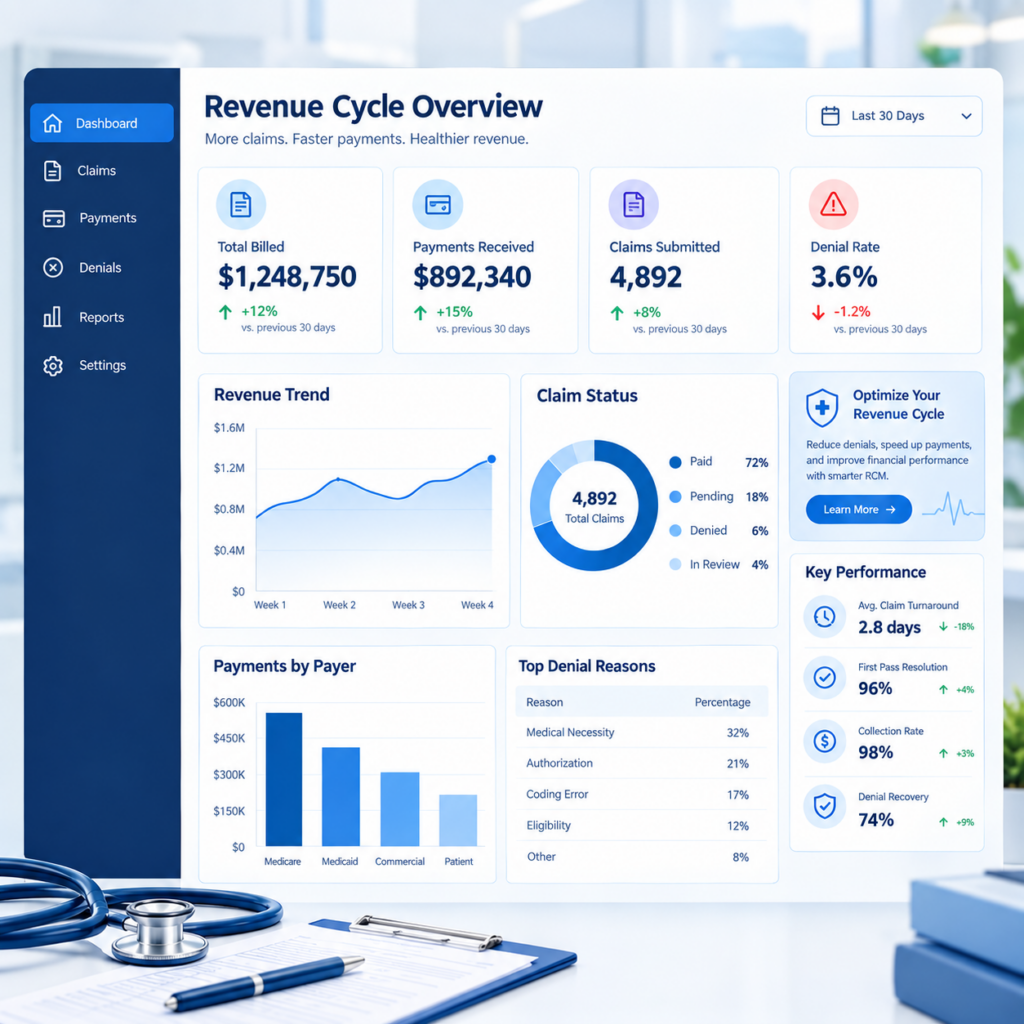
Why Emergency Medicine Billing Requires Specialized Expertise
High Patient And Claim Volume
Emergency departments can generate large volumes of encounters across different levels of clinical complexity and payer types. When registration information, charges, coding, or claims are not handled consistently, relatively small workflow problems can become larger accounts receivable issues. A structured billing process helps identify missing information, coding concerns, claim rejections, and unpaid accounts earlier in the revenue cycle.
Emergency Department E/M Coding
Emergency department evaluation and management services have specific CPT guidelines. The AMA’s current guidance notes that the 2023 E/M revisions extended important changes to emergency department services, including alignment of medical decision-making concepts with the broader E/M framework. For ED services, CPT maintains the principle that time is not used as the key criterion for selecting the code level.
That makes knowledgeable emergency medicine coding and documentation review important. Coding should reflect the services and medical decision-making supported by the provider’s documentation rather than assumptions about the patient’s condition.
Critical Care And Complex Emergency Services
Emergency physicians may provide critical care and other complex services when the applicable requirements are met. These encounters require careful attention to documentation and coding. CMS emphasizes that medical records should support the CPT, HCPCS, and ICD-10-CM codes reported on claims and that medical necessity is a central consideration for payment.
Multiple Payers And Different Requirements
Emergency medicine groups may bill commercial insurers, Medicare, Medicaid, workers’ compensation programs, and other payers. Requirements can differ between plans and jurisdictions. Eligibility problems, incorrect patient information, missing documentation, coding issues, claim edits, and payer-specific requirements can all affect claim processing. Effective claims management therefore requires more than simply sending claims electronically.
Our Emergency Medicine Billing Services
Kaizen Systems supports key stages of the emergency medicine revenue cycle.
Insurance Verification And Eligibility
Accurate patient and insurance information provides an important foundation for billing. Our workflow can help verify available coverage information and identify potential eligibility issues that could affect claims.
Charge Capture And Charge Entry
Emergency medicine encounters can include E/M services, procedures, and other reportable services. Effective charge capture helps ensure that documented services are represented accurately in the billing workflow.
Charge information can then be reviewed for completeness and consistency before claim submission.
Emergency Medicine Coding And Claim Review
Emergency medicine coding requires familiarity with applicable CPT, HCPCS, ICD-10-CM, payer policies, and documentation requirements. Kaizen Systems can support coding and claim review processes for emergency physician services, including emergency department E/M services and applicable critical care or procedural services.
CMS reported that incorrect coding and insufficient documentation were among the major causes of improper E/M payments in its 2024 Medicare Fee-for-Service data, reinforcing the importance of documentation-supported coding.
Claims Submission And Monitoring
Claims should be prepared using the information supported by the patient’s record and billing workflow. After submission, claims need to be monitored for rejections, payer responses, requests for information, and payment status. Kaizen Systems can help organize this process so unresolved claims receive appropriate follow-up.
Payment Posting
Accurate payment posting helps maintain a reliable financial record for the practice. Payments, adjustments, contractual amounts, and remaining balances need to be recorded appropriately so that outstanding accounts can be identified and worked.
Denial Management
A denied claim is not always caused by the same problem. Denials may involve eligibility, coding, documentation, claim data, payer policy, or other administrative issues.
Kaizen Systems can help categorize denial reasons, identify appropriate corrective actions, submit corrected claims or appeals when appropriate, and monitor recurring denial patterns.
Accounts Receivable Management
Unresolved A/R can become increasingly difficult to manage when older balances are not actively monitored. Our A/R workflow can include reviewing aging accounts, checking claim status, following up with payers, researching outstanding balances, and escalating accounts that require additional attention.
Underpayment Review
A claim may be processed and paid without necessarily resolving the account correctly. Reviewing remittance information and applicable reimbursement terms can help identify accounts that warrant additional investigation.
Reporting And Revenue Cycle Monitoring
Clear reporting helps emergency medicine groups understand what is happening across their billing operation.
Depending on the engagement, reporting can provide visibility into areas such as:
- Claim status
- Denial activity
- A/R aging
- Payment activity
- Outstanding balances
- Payer trends
- Billing workflow issues
This information can help practice managers identify recurring problems and make informed operational decisions.
Emergency Medicine Coding And Documentation Support
Good emergency medicine billing starts with accurate clinical documentation. CMS states that documentation should support the codes reported and that providers should not report a higher E/M level when the documented service does not support it.
For emergency medicine, this may involve reviewing documentation relevant to:
- Emergency department E/M services
- Medical decision making
- Diagnoses
- Procedures
- Critical care services
- Other services supported by the medical record
The AMA explains that emergency department E/M coding was included in the broader 2023 E/M revisions, with updated descriptors and MDM concepts. Kaizen Systems’ billing approach is centered on documentation-supported coding. Billing teams should not infer clinical facts that are not documented or select codes simply to increase reimbursement. The objective is accurate, compliant reporting of services actually provided.
Why Choose Kaizen Systems For Emergency Medicine Billing?
A billing partner should understand that emergency medicine is not simply another specialty billing workflow.
Kaizen Systems focuses on the operational areas that matter to emergency medicine physician groups: claims management, coding support, denial resolution, A/R management, payment posting, and reporting.
We emphasize clear communication and organized workflows rather than unsupported promises about guaranteed collections or claim approval. Billing performance can be affected by payer contracts, patient demographics, documentation, coding, claim type, reimbursement policies, and other factors outside a billing company’s control. Our goal is to provide practical billing and RCM support that fits the organization’s existing processes and gives decision-makers useful information about their revenue cycle.
Frequently Asked Questions
What Is Emergency Medicine Billing?
Emergency medicine billing is the process of managing the financial side of professional emergency care services. It can include eligibility verification, charge capture, coding, claim submission, payment posting, denial management, A/R follow-up, and reporting.
How Is Emergency Medicine Billing Different From General Medical Billing?
Emergency medicine involves unpredictable patient presentations, high encounter volumes, emergency department E/M services, complex procedures, critical care in applicable cases, and multiple payer requirements. These factors create billing and coding considerations that are specific to emergency care.
What Services Are Included In Emergency Medicine Billing?
Services may include insurance verification, charge capture, emergency medicine coding, claim submission, payment posting, denial management, A/R follow-up, underpayment review, patient billing support, and revenue-cycle reporting.
How Does Denial Management Help Emergency Medicine Practices?
Denial management identifies why claims were denied or not processed as expected and determines the appropriate next step. Depending on the issue, this may involve correcting claim information, submitting additional documentation, filing an appeal, or addressing a recurring workflow problem.
Why Is Accurate Emergency Medicine Coding Important?
Accurate coding helps ensure that claims represent the services documented in the medical record and comply with applicable coding requirements. CMS identifies incorrect coding and documentation problems among significant causes of improper E/M payments.
Can Kaizen Systems Manage The Complete Emergency Medicine Revenue Cycle?
Kaizen Systems can support multiple stages of the emergency medicine revenue cycle, including eligibility, charge capture, coding support, claims, payment posting, denials, A/R follow-up, and reporting. The exact scope can be structured according to the needs and workflow of each emergency medicine group.
Strengthen Your Emergency Medicine Billing Workflow With Kaizen Systems
Emergency medicine billing requires coordination across documentation, coding, charge capture, claims, payer follow-up, denials, payments, and accounts receivable. A structured emergency medicine RCM process can give physician groups better visibility into their billing operations while reducing the administrative work associated with managing claims and outstanding balances.
Kaizen Systems provides medical billing and revenue cycle support for emergency medicine associates and healthcare organizations. Contact Kaizen Systems to discuss your current billing workflow, identify areas that need attention, and determine the billing support that fits your organization.